How to Reduce Restaurant Startup Costs in India with Smart Equipment Buying
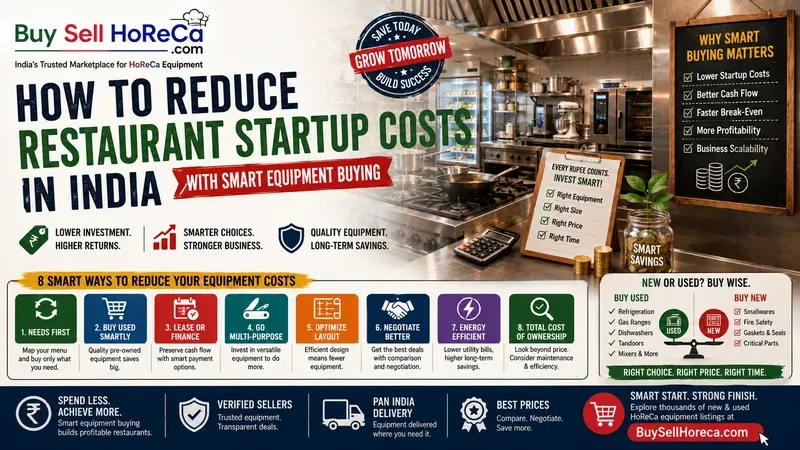
Opening a restaurant in India is one of the most exciting — and expensive — entrepreneurial ventures you can undertake. Between the lease deposit, interior fit-out, licensing fees, staff hiring, and marketing, the capital requirement adds up fast. For most first-time restaurant owners, kitchen equipment alone can consume 30–40% of the total startup budget.
The good news? With a strategic approach to equipment buying, you can significantly reduce your initial outlay without compromising on quality, safety, or operational efficiency. This guide walks you through every smart buying decision that can trim your restaurant startup costs in India — from choosing the right procurement model to knowing exactly which equipment to buy new versus used.
Why Kitchen Equipment Costs Spiral Out of Control
Before addressing solutions, it helps to understand why so many restaurateurs overspend on equipment at the outset.
The "buying everything new" trap is the most common mistake. First-time restaurant owners, excited about their new venture, often purchase brand-new equipment across the board — even for items where pre-owned alternatives work just as well at a fraction of the price.
Over-specification is the second culprit. A 40-litre combi oven for a 30-cover café, or a 50 kg/hour ice machine for a small QSR, are classic examples of buying far beyond operational needs. Equipment is often sized for an imagined peak capacity rather than realistic daily output.
Impulse purchasing from equipment dealers who upsell unnecessary add-ons, extended warranties, and bundled accessories that add cost without proportionate value is another common trap.
Underestimating the secondhand market is perhaps the biggest missed opportunity. India has a growing and well-stocked market for pre-owned commercial kitchen equipment — much of it barely used, sourced from restaurant closures, hotel renovations, or upgraded establishments. Platforms like BuySellHoreca.com have made this market transparent, verified, and accessible to buyers across the country.
1. Start with a Realistic Equipment Needs Assessment
The foundation of cost-efficient equipment buying is understanding exactly what you need — not what looks impressive in a showroom.
Map your menu to your equipment list. Every item on your menu requires specific equipment to produce it. Work backwards from your planned menu to create a precise equipment list. A cloud kitchen running a focused burger and wrap menu does not need a tandoor, a dosa tawa, or a pasta boiler — even if they seem like good additions "for later."
Calculate capacity realistically. Base equipment sizing on your expected daily cover count during the first six months — not on a best-case scenario five years from now. A 100-cover restaurant running two services a day needs very different equipment capacity than a 300-cover banquet operation. Buying for current realistic capacity and scaling up later is almost always cheaper than buying oversized equipment upfront.
Separate must-haves from nice-to-haves. Categorise every item on your equipment list into three buckets:
Essential — cannot operate without it (primary cooking equipment, refrigeration, dishwashing)
Important — significantly improves efficiency but alternatives exist (food processors, blast chillers)
Desirable — adds convenience or premium capability but not operationally critical at launch (espresso machines, combi ovens, specialist pasta equipment)
Launch with the essentials. Add important and desirable items as revenue justifies the investment.
2. Buy Used Equipment Strategically — and Safely
Buying pre-owned commercial kitchen equipment is the single highest-impact decision you can make to reduce restaurant startup costs in India. The savings are substantial: well-maintained used commercial equipment typically costs 40–70% less than new equivalents.
Which Equipment is Safe to Buy Used?
High value, low risk — ideal candidates for pre-owned purchase:
Commercial refrigerators and walk-in cold rooms
Commercial gas ranges and burner stations
Tandoors (inspect the clay lining and blower motor)
Stainless steel workbenches, shelving, and prep tables
Commercial dishwashers (check descaling history and spray arm condition)
Exhaust hoods and canopies
Commercial mixers and dough kneaders
Griddles, grills, and tilting pans
Display counters and hot/cold bain marie units
Fryers (inspect heating elements and thermostat)
Exercise caution or buy new:
Refrigeration compressors with unknown service history
Equipment with no manufacturer support or discontinued spare parts
Older models with inefficient energy consumption that increases operating costs
Combi ovens with complex electronic controls if repair support is unavailable locally
Always buy new:
Small wares in direct food contact (knives, cutting boards, gastronorm containers)
Gaskets, seals, and consumable parts (these should be replaced anyway on used equipment)
Fire suppression system components
Where to Buy Used Commercial Kitchen Equipment in India
BuySellHoreca.com is India's dedicated marketplace for buying and selling new and pre-owned HoReCa equipment. The platform aggregates listings from verified sellers across the country — from individual restaurant owners selling surplus equipment to hotels undergoing renovation and institutional kitchens upgrading their fleet. Buyers get access to equipment across all categories with transparent pricing, seller details, and the ability to compare options before purchase.
Other sources include hotel auctions (when large properties renovate or close), restaurant closures (approach through brokers or trade networks), equipment dealers who carry certified refurbished stock, and catering college surplus sales.
How to Evaluate Used Equipment Before Buying
Inspect in person where possible — photographs do not reveal compressor noise, burner jet condition, or structural rust
Ask for the service history — has it been under an AMC? Were repairs done by authorised technicians?
Check for spare parts availability — search for the brand and model online; ensure parts are available in India
Run it before you buy — insist on a live demonstration; test all burners, check refrigeration temperatures, run a wash cycle
Factor in refurbishment costs — a used dishwasher at ₹40,000 may need ₹8,000 in descaling, new spray arms, and a door gasket — still far cheaper than new, but account for it
Negotiate based on condition — unlike retail, used equipment pricing has more flexibility
3. Lease or Finance Equipment Instead of Buying Outright
Not everything needs to be purchased with upfront capital. Equipment leasing and financing are underutilised tools in the Indian restaurant industry that can dramatically reduce the cash requirement at launch.
Equipment leasing allows you to use commercial kitchen equipment in exchange for monthly payments, without owning the asset. At the end of the lease term, you typically have the option to buy, renew, or return. This is particularly attractive for:
High-cost equipment like combi ovens, blast chillers, and commercial dishwashers
Equipment with rapid technology evolution (espresso machines, POS-integrated equipment)
Seasonal operations or pop-up restaurants with uncertain longevity
Equipment financing (loan against equipment) allows you to purchase equipment and pay in EMIs, using the equipment itself as collateral. Several NBFCs and banks in India, including HDFC Bank, ICICI Bank, and Bajaj Finserv, offer equipment financing for food businesses. Interest rates typically range from 12–18% per annum for small restaurants.
Vendor financing is offered directly by larger equipment suppliers and manufacturers. Some commercial kitchen equipment brands in India offer zero-cost EMI schemes for 6–12 months on select products — particularly when purchasing through authorised dealers.
The key calculation: compare the monthly EMI or lease cost against the opportunity cost of that capital deployed elsewhere in your business — in working capital, marketing, or staff training, which may generate returns faster than the equipment itself.
4. Buy Multi-Purpose Equipment to Reduce SKU Count
Every piece of equipment in your kitchen is a capital cost, a maintenance cost, and a space cost. Reducing your equipment count by investing in versatile, multi-purpose units has a compounding effect on savings.
Combi oven vs. a battery of appliances. A commercial combi oven can function as a convection oven, steamer, and combination roaster. For a bakery-café or multi-cuisine restaurant, one mid-size combi oven can replace three separate appliances — with better results and lower total cost over five years.
Tilting braising pan (tilting skillet). One of the most versatile pieces of equipment in a commercial kitchen, the tilting braising pan can braise, boil, fry, and hold food. For large-volume Indian cooking, it can replace separate stock pot burners, bain marie units, and griddles.
Planetary mixer with attachments. A single planetary mixer fitted with different attachments (hook, paddle, whisk) handles dough, batter, mashed preparations, and more. Rather than buying a dedicated dough kneader and a separate mixer, one well-chosen planetary mixer covers both.
Pass-through vs. undercounter refrigeration. In a small kitchen, under-counter refrigeration units serve double duty as workspace and cold storage — eliminating the need for a separate prep table above and a floor-standing refrigerator that would occupy more space.
5. Right-Size Your Kitchen Layout to Avoid Unnecessary Equipment
The layout of your commercial kitchen directly determines how much equipment you need. An inefficient layout creates workflow gaps that restaurant owners fill with additional equipment — adding cost unnecessarily.
Zone-based kitchen design divides the kitchen into logical functional zones: receiving and storage, prep, cooking, plating, washing, and waste. Each zone is equipped only with what that function requires, eliminating redundant equipment placed for convenience.
Compact linear layouts work best for cloud kitchens, QSRs, and small cafés. By aligning prep and cooking stations along a single run, you reduce the need for pass-through equipment and intermediate holding units.
Engage a kitchen consultant before finalising equipment. Many commercial kitchen equipment suppliers in India offer free or low-cost layout consultation as part of a purchase package. A well-designed kitchen can reduce your equipment list by 15–20% compared to an ad hoc purchase approach.
6. Negotiate Aggressively — and Know Your Leverage Points
Unlike retail consumer purchases, commercial kitchen equipment procurement in India has significant room for negotiation — especially when buying multiple items.
Bundle purchases for volume discounts. If you are outfitting an entire kitchen, approach two or three suppliers with your full equipment list and invite competing quotes. Even a 10–15% discount on a ₹15 lakh equipment package saves ₹1.5–2.25 lakh.
Ask for installation and commissioning included. Many suppliers charge separately for delivery, installation, and commissioning. In a competitive quote situation, insist these are bundled at no extra cost.
Negotiate AMC terms into the purchase price. A one or two-year AMC included at the time of purchase is often cheaper than purchasing it separately post-installation — and provides peace of mind during the critical first year of operation.
Leverage end-of-quarter timing. Equipment dealers — particularly for branded equipment — often have quarterly sales targets. Approaching at the end of March, June, September, or December can yield better pricing and terms.
Compare imported vs. Indian-made equipment. India has a robust domestic commercial kitchen equipment manufacturing industry, particularly in cities like Pune, Mumbai, Delhi NCR, and Coimbatore. Indian-made equipment often offers comparable build quality to imported alternatives at 30–50% lower cost, with the added advantage of readily available local spare parts and service support.
7. Prioritise Energy-Efficient Equipment to Reduce Operating Costs
Reducing startup costs is only half the equation. Equipment that is cheap to purchase but expensive to operate erodes your margins over time.
Energy efficiency directly affects your monthly P&L. A commercial refrigerator running 24 hours a day, 365 days a year, is one of the highest electricity consumers in any restaurant. An older, inefficient unit may cost ₹3,000–4,000 per month more to run than a modern energy-efficient equivalent. Over three years, that differential exceeds the cost of buying the more efficient model new.
Look for BEE star ratings on refrigeration equipment. The Bureau of Energy Efficiency (BEE) star rating system applies to commercial refrigeration in India. A 5-star rated unit uses significantly less electricity than a 1-star or unrated equivalent.
Induction cooking for certain applications. While traditional gas cooking remains the backbone of most Indian commercial kitchens, induction cooktops for specific prep tasks (stock reduction, sauce finishing, tempering) offer significant energy savings and reduce heat load in the kitchen — lowering your air-conditioning costs as well.
LED lighting throughout the kitchen. Replacing fluorescent or halogen lighting with LED in kitchen and cold storage areas reduces electricity consumption by up to 60% for lighting — a small but compound saving over time.
8. Avoid These Common Equipment Buying Mistakes
Do not buy equipment before finalising the menu. The sequence matters. Menu → equipment list → layout → procurement. Buying equipment speculatively before your menu is finalised leads to mismatched purchases and expensive corrections.
Do not pay full retail for stainless steel fabrication. Stainless steel workbenches, shelving units, sinks, and prep tables are extensively fabricated locally across India at competitive prices. Getting these fabricated by a local SS fabricator is typically 30–40% cheaper than buying branded equivalents — with no compromise in functionality.
Do not ignore total cost of ownership. A cheap burner range from an unbranded manufacturer may save ₹20,000 upfront but cost ₹15,000 a year in repairs due to poor build quality and unavailable spare parts. Research the brand's service network in your city before purchasing.
Do not purchase at the first quote. The first price you receive from any equipment vendor is rarely their best. Always obtain at least three competitive quotes for any significant purchase.
Do not overlook utility connections. The cost of gas pipeline connection, electrical load enhancement, and water supply augmentation must be factored into your equipment procurement plan. Some equipment choices — such as a combi oven requiring a 3-phase power connection — have infrastructure cost implications beyond the equipment price itself.
A Practical Framework: New vs. Used vs. Lease Decision Matrix
The BuySellHoreca.com Advantage
BuySellHoreca.com was built specifically for the Indian HoReCa (Hotel, Restaurant, Café) industry's equipment needs. Whether you are setting up your first restaurant, expanding an existing chain, or upgrading your cloud kitchen infrastructure, the platform offers:
Thousands of verified listings for new and pre-owned commercial kitchen equipment
Buyers across all major Indian cities — Delhi NCR, Mumbai, Bengaluru, Hyderabad, Chennai, Pune, and more
Transparent seller information for confident purchasing decisions
Equipment across all categories — cooking, refrigeration, warewashing, bakery, bar, and more
A sell-side platform for restaurants looking to liquidate surplus or replaced equipment
Smart equipment buying starts with access to the right market. Explore listings on BuySellHoreca.com before making any purchase decision — the savings you find there may be the difference between a tight launch budget and a comfortable one.
Final Thoughts
Reducing restaurant startup costs in India is not about cutting corners — it is about cutting waste. Waste in the form of over-specification, impulse buying, ignoring the pre-owned market, and failing to negotiate. Every rupee saved on smart equipment procurement is a rupee available for the things that directly generate revenue: great food, trained staff, and marketing that fills tables.
Apply the framework in this guide: map your menu, right-size your equipment, explore the pre-owned market, consider leasing for high-cost items, negotiate aggressively, and always factor in total cost of ownership. Your restaurant's financial health begins before the first dish is served — it begins with the decisions you make during setup.
Ready to start buying smarter? Browse thousands of new and pre-owned commercial kitchen equipment listings at BuySellHoreca.com — India's dedicated HoReCa marketplace.