Café Equipment List for a Small Coffee Shop in India
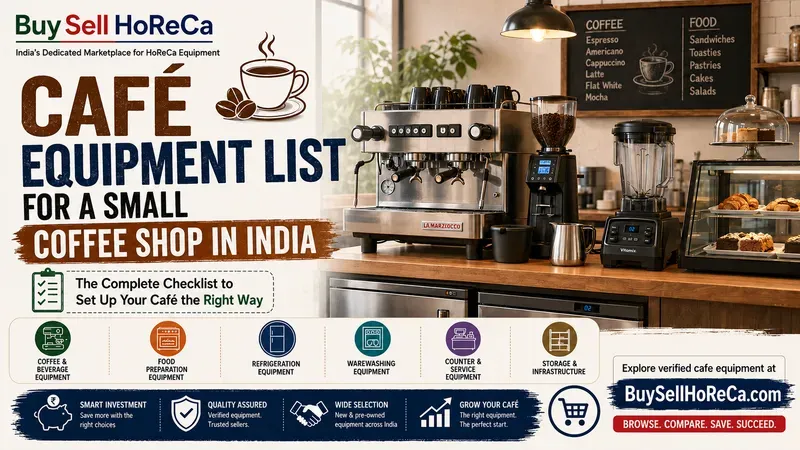
India's café culture has never been more vibrant. From specialty espresso bars in Bengaluru's Indiranagar to all-day brunch cafés in Mumbai's Bandra, and cosy student hangouts in Pune's FC Road — the small coffee shop format has become one of the most aspirational and financially accessible restaurant ventures in the country.
But excitement aside, the success of a small café hinges on one foundational decision made before the first cup is pulled: getting the equipment list right.
Over complicate it, and you blow your budget on machines you will use twice a week. Under-equip, and you create operational bottlenecks that slow service and frustrate customers during peak hours. The goal is a lean, well-considered equipment setup that matches your concept, your menu, and your realistic daily volume.
This guide is the definitive café equipment checklist for small coffee shops in India — covering everything from the espresso machine to the last shelf bracket, with buying advice, approximate cost ranges, and guidance on what to prioritise at launch versus what can wait.
Before You Build Your Equipment List
Two decisions upstream of your equipment list will shape everything else.
Your café concept determines your equipment. A pure-play specialty coffee bar with a tight espresso menu needs different equipment than a café-bakery offering full brunch plates and house-baked goods. A bubble tea café has almost no overlap with an Italian espresso bar. Define your concept and your opening menu before spending a rupee on equipment.
Your daily cover count determines your equipment scale. A 20-seat neighbourhood café doing 60–80 transactions a day runs very differently from a 40-seat all-day café doing 200+. Right-sizing to your realistic first-year volume is the difference between efficient and wasteful capital allocation.
With those anchors in place, here is the complete equipment list.
Section 1: Coffee and Beverage Equipment
This is the heart of your café. These are the machines your customers come for, and the ones that most directly affect the quality of what you serve.
1. Espresso Machine
The espresso machine is the single most important investment in any coffee-focused café. In India, you have three practical options:
Semi-automatic espresso machines give the barista full control over extraction — ideal for specialty coffee concepts where consistency and craft are part of the experience. Brands well-represented in India include La Marzocco, Rancilio, Nuova Simonelli, Rocket Espresso, and Jura (commercial). For a small café doing up to 100 espresso-based drinks a day, a quality 2-group semi-automatic is the standard.
Super-automatic espresso machines grind, dose, tamp, and extract at the push of a button — ideal for cafés where speed and consistency matter more than artisanal positioning, or where trained baristas are difficult to retain. Jura, DeLonghi (commercial), and Franke are reliable options.
Filter coffee machines / South Indian filter coffee equipment — if your concept is rooted in filter coffee culture (a growing segment in Indian cafés), the equipment set changes significantly: a good percolator or South Indian drip filter system, a stainless steel tumbler-and-dabara set, and a milk frothing solution take precedence over an espresso machine.
Approximate cost range:
Entry-level commercial 2-group semi-auto: ₹1.5–3 lakh (new); ₹60,000–1.5 lakh (used)
Mid-range 2-group (La Marzocco Linea Mini, Rancilio Classe): ₹3–6 lakh (new)
Super-automatic commercial: ₹1.5–4 lakh (new)
Buying tip: The espresso machine is where leasing makes sense if capital is tight. Many commercial espresso machine suppliers in India offer lease-to-own or monthly rental schemes — explore this before buying outright.
2. Coffee Grinder(s)
A good grinder is arguably more important than the espresso machine — inconsistent grind size is the most common cause of poor espresso quality. Never scrimp here.
For espresso, you need a dedicated on-demand espresso grinder that doses directly into the portafilter. Brands available in India include Mahlkönig, Eureka, Mazzer, and Compak. For a small café, a single high-quality grinder suffices at launch; add a second dedicated to decaf or filter if volume justifies it.
If you are serving filter coffee (pour-over, Aeropress, batch brew), a separate coarser-grind option is needed — or a switchable grinder if budget is a constraint.
Approximate cost range:
Quality espresso grinder (Eureka Mignon, Compak E5): ₹35,000–80,000 (new); ₹15,000–40,000 (used)
Professional mid-range (Mahlkönig E65S): ₹1–1.5 lakh (new)
3. Batch Brew / Filter Coffee Machine
For a café serving black coffee, Americanos, and drip coffee — and for staff drinks and morning service where speed matters — a good commercial batch brewer is an efficient addition. Brands like Bravilor Bonamat and Bunn are widely available through Indian distributors.
Approximate cost range: ₹25,000–70,000 (new)
4. Commercial Blender
A high-powered commercial blender is essential if your menu includes frappes, cold coffee blends, smoothies, or thickshakes — all of which are high-margin, high-demand items in Indian cafés. The Vitamix Quiet One and Blendtec Stealth are the commercial standards; Hamilton Beach commercial models offer a more budget-accessible option.
Do not use domestic blenders in a café environment — the motor burnout rate under commercial use is high.
Approximate cost range:
Mid-range commercial blender: ₹25,000–50,000 (new)
Premium (Vitamix Quiet One): ₹70,000–1 lakh (new)
5. Ice Machine / Ice Maker
If your café serves cold coffee, iced drinks, or cold beverages of any kind — which virtually every Indian café does — an ice machine is non-negotiable. Assess your daily ice requirement by estimating iced drink volume. A small café doing 40–60 cold drinks a day needs a machine producing at least 20–30 kg of ice daily.
Brands well-supported in India include Hoshizaki, Scotsman, and ITV Ice Makers.
Approximate cost range:
Small under-counter ice machine (20–30 kg/day): ₹45,000–90,000 (new); ₹20,000–50,000 (used)
6. Milk Refrigerator / Under-Counter Chiller (Dedicated)
Fresh milk is the highest-volume perishable in most Indian cafés — entire and full-fat for espresso drinks, oat milk, almond milk, and toned milk depending on your menu. A dedicated under-counter milk chiller at the coffee station eliminates the need to walk to a back-room refrigerator during service, dramatically improving bar efficiency.
Approximate cost range: ₹18,000–35,000 (new); ₹8,000–18,000 (used)
7. Cold Brew Equipment (Optional at Launch)
Cold brew coffee has significant margins and can be prepared in batches during off-peak hours. If your menu includes cold brew, you need either a dedicated cold brew tower (aesthetic but expensive) or simple food-grade immersion vessels that fit in your refrigerator. Start with the latter at launch — upgrade to a tower if cold brew becomes a signature product.
Approximate cost range: ₹2,000–8,000 (immersion vessels); ₹40,000–1.2 lakh (cold brew tower)
Section 2: Food Preparation Equipment
Even a "coffee-first" café typically serves some food — toasted sandwiches, baked goods, light bites. This section covers the food equipment needed for the most common small café menus in India.
1. Commercial Toaster / Conveyor Toaster
For a café serving toasted sandwiches, bagels, or artisan bread — a commercial conveyor toaster is the workhorse. It handles consistent throughput without occupying staff attention. For lower volume, a pop-up commercial toaster or a contact grill (panini press) suffices.
Approximate cost range:
Pop-up commercial toaster (4-slice): ₹8,000–18,000 (new)
Commercial conveyor toaster: ₹25,000–60,000 (new); ₹12,000–30,000 (used)
2. Panini Press / Contact Grill
A contact grill (panini press) is perhaps the most versatile piece of food equipment in a small café kitchen — grilled sandwiches, quesadillas, wraps, and toasties all come off the same machine. Invest in a commercial-grade press from Bravetti, Waring, or Birko; domestic models will not withstand service volumes.
Approximate cost range: ₹12,000–35,000 (new); ₹6,000–18,000 (used)
3. Commercial Microwave (Heavy-Duty)
A commercial microwave with a minimum 1,000W output handles reheating, defrosting, and warming with the durability that domestic microwaves lack. Brands like Panasonic Commercial, Samsung Commercial, and LG commercial models are widely available in India.
Approximate cost range: ₹12,000–25,000 (new)
4. Convection Oven / Deck Oven (If Serving Baked Goods)
If your café serves croissants, muffins, cookies, or any freshly baked product — even if sourced from a bakery and warmed on-site — a small commercial convection oven is essential. If you are baking in-house, a deck oven or a combination of deck and convection provides the range for breads, pastries, and cakes.
Approximate cost range:
Small commercial convection oven (4-tray): ₹25,000–55,000 (new); ₹12,000–28,000 (used)
2-deck bakery oven: ₹45,000–1.2 lakh (new); ₹20,000–60,000 (used)
5. Prep Surfaces and Smallwares
Every small café kitchen needs a functional food prep setup, even if food preparation is minimal:
Stainless steel prep table (1200mm × 600mm minimum): ₹8,000–16,000 (local fabrication)
Commercial cutting boards (colour-coded, minimum 2): ₹1,500–4,000
Chef's knives and serrated bread knife set: ₹3,000–8,000
Mixing bowls (stainless steel, set of 3–4): ₹1,500–3,000
Gastronorm containers with lids (for ingredient storage): ₹3,000–6,000
Squeeze bottles and dispensers (sauces, syrups): ₹1,000–2,500
Section 3: Refrigeration Equipment
1. Back-Bar / Under-Counter Refrigerator (2-door)
A 2-door under-counter refrigerator behind the service counter is the backbone of cold storage for day-to-day café operations — storing milk, juices, cold brew, desserts, and prepped ingredients within arm's reach of service staff.
Approximate cost range: ₹25,000–50,000 (new); ₹12,000–28,000 (used)
2. Display Refrigerator / Cake Display Counter
A glass-front display refrigerator or patisserie counter is both a functional cold storage unit and a marketing tool — displaying cakes, pastries, sandwiches, and bottled beverages at the point of purchase drives impulse sales significantly. For a small café, a countertop or under-counter display chiller (60cm–120cm wide) is typically sufficient.
Approximate cost range:
Countertop display chiller: ₹18,000–35,000 (new); ₹8,000–20,000 (used)
Under-counter glass-door display: ₹28,000–55,000 (new); ₹14,000–30,000 (used)
3. Upright Refrigerator (Back-of-House Storage)
A full-height upright refrigerator in the back kitchen or storage area handles bulk cold storage — weekly dairy orders, packaged ingredients, prepared items. A good BEE 5-star rated unit here pays back in energy savings over time.
Approximate cost range: ₹20,000–45,000 (new); ₹9,000–22,000 (used)
4. Deep Freezer (If Required)
Required if your menu includes ice cream, frozen desserts, frozen dough, or any frozen ingredient. A chest freezer is cost-efficient for storage; an upright freezer is more convenient for frequent access.
Approximate cost range: ₹15,000–30,000 (new); ₹7,000–16,000 (used)
Section 4: Warewashing Equipment
1. Under-Counter Dishwasher / Glass Washer
In a small café, an under-counter commercial dishwasher or dedicated glass washer is essential for maintaining service speed and hygiene. A glass washer cycle takes 90–120 seconds — fast enough to keep up with continuous service in a busy café. Brands including Winterhalter, Meiko, and Classeq have authorised service in major Indian cities.
Approximate cost range:
Under-counter glass washer: ₹55,000–1.1 lakh (new); ₹25,000–55,000 (used)
Under-counter dishwasher: ₹65,000–1.3 lakh (new); ₹30,000–65,000 (used)
2. Three-Compartment Sink
A three-compartment sink (wash, rinse, sanitise) is a mandatory requirement under FSSAI food safety guidelines for food service establishments. It handles hand-washing of equipment, smallwares, and any items not suitable for the dishwasher. Local stainless steel fabrication is the most cost-effective option.
Approximate cost range: ₹8,000–18,000 (local SS fabrication)
3. Handwashing Sink (Dedicated)
FSSAI mandates a separate, dedicated handwashing sink in the food preparation area — it must not be used for equipment washing. Wall-mounted with liquid soap dispenser and paper towel holder.
Approximate cost range: ₹4,000–9,000 (local SS fabrication + fittings)
Section 5: Counter, Service, and Front-of-House Equipment
1. Service Counter / Bar Counter
The service counter is the centrepiece of the café's front-of-house — it should be designed for workflow efficiency (barista movement, equipment placement, customer interaction) as much as aesthetics. For a small café, a custom-fabricated counter in stainless steel (back-bar) with a finished front (wood, tiles, or solid surface) is typically the best value.
Approximate cost range: ₹60,000–2 lakh+ depending on materials, size, and finish (custom fabrication)
2. Knock Box (Espresso)
A countertop knock box for spent espresso pucks — small but essential for barista workflow. Built-in bar knock boxes are also available.
Approximate cost range: ₹1,500–4,500
3. Tamper, Distribution Tool, and Portafilter Accessories
A quality tamper calibrated to your portafilter basket diameter is non-negotiable — inconsistent tamping is a root cause of extraction problems. A distribution tool (WDT or Stockfleeth) ensures even puck preparation.
Approximate cost range: ₹2,000–8,000 (quality tamper + distribution tool)
4. Milk Steaming Pitchers (Multiple)
A minimum of three to four milk pitchers in different sizes (350ml, 600ml, 1L) allows baristas to steam multiple milk orders simultaneously and prepare different sizes efficiently.
Approximate cost range: ₹600–1,800 per pitcher; budget ₹5,000–8,000 for a full set
5. Thermometers (Milk and Food)
Calibrated thermometers for milk steaming (50–65°C range for lattes; 70°C for those who request it) and food temperature monitoring. Magnetic clip-on thermometers are practical for milk pitchers.
Approximate cost range: ₹800–2,500 per unit; budget ₹3,000–5,000 for a set
6. POS System (Point of Sale)
A cloud-based POS system handles billing, inventory tracking, sales reporting, and — in larger setups — integration with delivery platforms. In India, Petpooja, Posist, and GoFrugal are widely used by small cafés; Rista and UrbanPiper are popular for delivery-integrated setups.
The hardware — tablet or touchscreen terminal, receipt printer, and cash drawer — needs to be accounted for separately.
Approximate cost range:
POS software: ₹1,200–3,500/month (SaaS subscription)
Hardware (tablet + printer + drawer): ₹18,000–40,000
7. Receipt Printer and Cash Drawer
Even with a digital POS, a thermal receipt printer and secure cash drawer are standard café equipment in India.
Approximate cost range: ₹4,000–9,000 (printer + drawer combo)
Section 6: Storage and Infrastructure
1. Dry Storage Shelving (Stainless Steel or Epoxy-Coated Wire)
Dedicated shelving for dry goods — coffee beans, syrups, packaging, consumables — should be organised, labelled, and elevated off the floor per FSSAI guidelines. Wire shelving is ventilated and easy to clean; stainless steel is more durable in humid conditions.
Approximate cost range: ₹4,000–10,000 per unit (local SS fabrication or Unirak/Spacepro wire shelving)
2. Water Filtration / Softener System
Water quality directly affects espresso quality, machine longevity, and scale buildup in steamers and boilers. In most Indian cities, installing an inline water filter and softener on the espresso machine water supply is not optional — it is a maintenance necessity. BWT, Brita Professional, and Everpure are brands with Indian distribution.
Approximate cost range: ₹8,000–25,000 (filter + softener installation)
3. Voltage Stabiliser (Servo Type)
Power voltage fluctuations in India can damage sensitive electronics in espresso machines and grinders. A servo voltage stabiliser rated appropriately for your equipment load is a small investment that protects large ones.
Approximate cost range: ₹4,000–10,000
4. Exhaust Hood / Kitchen Ventilation
If your café has any cooking (toasting, grilling, baking), an exhaust hood over the cooking area is required under FSSAI Schedule 4 and most local municipal regulations. Even a compact café exhaust canopy above the cooking station improves air quality, reduces heat load, and keeps your café environment pleasant for guests.
Approximate cost range: ₹15,000–40,000 (local fabrication + fan motor)
Section 7: Café Furniture and Front-of-House
While not kitchen equipment, the front-of-house setup is part of the overall café investment. For completeness:
Tables (2-seater and 4-seater): ₹3,500–9,000 per table
Chairs: ₹1,500–5,000 per chair
Bar stools (if counter seating): ₹2,500–6,000 per stool
Menu boards (chalkboard or backlit): ₹3,000–15,000
Pendant lighting and ambience: ₹15,000–50,000+ (highly variable)
Full Equipment Checklist at a Glance
✅ Coffee and Beverage
Espresso machine (2-group semi-auto or super-auto)
Espresso grinder (dedicated, on-demand)
Batch brew / filter coffee machine (if applicable)
Commercial blender (for frappes and cold drinks)
Ice machine (min 20 kg/day production)
Under-counter milk chiller (dedicated at bar station)
Cold brew equipment (optional at launch)
✅ Food Preparation
Commercial toaster or conveyor toaster
Panini press / contact grill
Heavy-duty commercial microwave
Convection or deck oven (if baking on-site or warming pastries)
Stainless steel prep table
Cutting boards, knives, mixing bowls, gastronorm containers
✅ Refrigeration
Under-counter 2-door refrigerator (back bar)
Display refrigerator / cake counter
Upright refrigerator (back-of-house storage)
Deep freezer (if frozen items on menu)
✅ Warewashing
Under-counter dishwasher or glass washer
Three-compartment sink (SS fabrication)
Dedicated handwashing sink
✅ Counter and Service
Service bar counter (custom fabrication)
Knock box
Tamper and distribution tool
Milk steaming pitchers (set of 4)
Milk and food thermometers
POS system (hardware + software)
Receipt printer and cash drawer
✅ Storage and Infrastructure
Dry storage shelving
Water filtration and softener (inline, espresso machine)
Voltage stabiliser (servo type)
Exhaust hood and ventilation (if cooking)
Estimated Total Equipment Budget: Small Café in India
Note: Costs exclude furniture, interior fit-out, licensing, rental deposit, and pre-opening working capital.
A mixed procurement strategy — buying the espresso machine and grinder new (or leasing), and sourcing refrigeration, dishwashing, food prep, and stainless steel fabrication from the pre-owned market through platforms like BuySellHoreca.com — is how most successful small café launches in India manage their setup capital efficiently.
What to Buy New vs. Used for Your Café
Always buy new: Espresso machine (or lease), fire suppression components, food-contact smallwares, gas regulators, and water filters.
Strong candidates for pre-owned purchase: Refrigeration units, display chillers, glass washers, convection ovens, blenders, ice machines, and all stainless steel fabrication items.
Consider leasing: Espresso machines (especially premium brands), combi ovens, and POS hardware — where technology evolution and warranty matter most.
Final Thoughts
A small coffee shop in India can be set up with the right equipment for as little as ₹4–5 lakh on a smart mixed-procurement budget, or scaled to ₹15 lakh+ for a premium specialty concept with all-new equipment. The key is matching your equipment choices to your concept, your menu, and your realistic first-year volume — not to what looks impressive or what a vendor recommends.
Start with this checklist, map each item to your menu, and make procurement decisions category by category. For pre-owned equipment — refrigeration, display counters, dishwashers, ovens, and stainless steel fabrication — explore verified listings on BuySellHoreca.com, India's dedicated HoReCa marketplace, to find quality equipment at a fraction of the new price.
Ready to set up your café? Browse new and pre-owned café and coffee shop equipment across India at BuySellHoreca.com — your trusted HoReCa marketplace.
Frequently Asked Questions
Need a Printable Copy?
Download this commercial guide as a formatted PDF to share with your staff, technicians, or print for your kitchen workspace.