Buying Used Commercial Kitchen Equipment in India – A Step-By-Step Guide
Why Buy Used Commercial Kitchen Equipment in India?
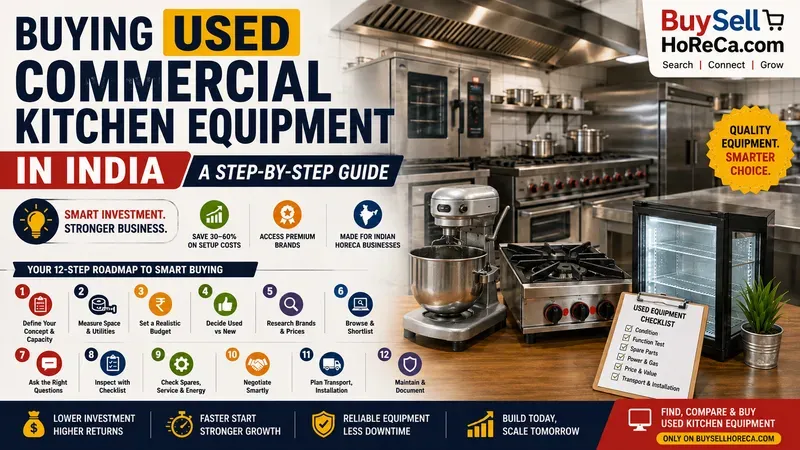
Buying pre-owned or refurbished kitchen equipment can reduce your upfront setup costs by 30–60% compared to purchasing everything new — a critical advantage for first-time entrepreneurs working with limited capital. It also gives you access to premium brands and heavy-duty commercial machines that would otherwise be out of budget at new prices.
For many Indian food businesses, this means a faster return on investment and more working capital available for rent, staff salaries, marketing, and raw materials. A cloud kitchen operator in Bengaluru, for example, can get fully equipped in 4–6 weeks by combining used commercial gas ranges, a refurbished cold room, and second-hand prep tables — at a fraction of the cost of an all-new fit-out.
However, buying second-hand restaurant equipment in India without a clear process can lead to breakdowns, downtime, and hidden costs that wipe out your initial savings. That is why following a structured, step-by-step approach is essential.
Step 1: Define Your Concept, Menu, and Capacity
Before browsing any listings, get complete clarity on what your kitchen needs to do every single day.
Lock in your food concept. Is it a multi-cuisine restaurant, a regional thali outlet, a bakery, a QSR, a cloud kitchen, or a café? A biryani cloud kitchen in Hyderabad will need very different equipment from a tandoor-heavy North Indian dhaba or a bakery running three deck ovens.
Finalise the core menu. Write down your must-serve items. For each dish, list the equipment it requires — fryer, range, tandoor, combi oven, refrigerator, mixer, dough sheeter, prep tables, and so on. This becomes your equipment shortlist.
Estimate daily order volume. How many covers or orders do you expect per day in the first 3–6 months? This determines the capacity — litres, trays, kW output — of the ovens, fryers, cold storage, and refrigerators you should be looking at.
This clarity prevents you from over-buying expensive equipment you do not need, or under-sizing a machine that will become a daily bottleneck.
Step 2: Measure Your Kitchen Space and Utilities
Even the most attractive used equipment deal is useless if the machine does not physically fit your kitchen or match your power supply.
Measure all critical dimensions: Note the length, breadth, and height of your cooking line, prep area, dishwashing zone, and walkways. Leave at least 90 cm of walkway for staff movement and safe cleaning access.
Check your sanctioned electrical load: Confirm whether your connection is single phase or three phase, and how many heavy-load appliances you can run simultaneously. Commercial ovens, deep freezers, and dishwashers typically demand three-phase supply.
Assess gas and ventilation: If you use LPG or piped natural gas (PNG), confirm safe pipe routing and adequate exhaust hood coverage. Some imported or older equipment may not be compatible with Indian gas fittings without an adaptor.
Plan water and drainage points: Dishwashers, prep sinks, and ice machines need specific inlet and outlet points. Always check that the equipment's connections align with your existing plumbing before paying a deposit.
Keep these measurements with you when browsing BuySellHoReCa listings so you can instantly filter out equipment that simply will not fit.
Step 3: Set a Realistic Budget — Including All Hidden Costs
Used restaurant equipment is cheaper upfront, but there are additional costs that many first-time buyers miss when comparing restaurant equipment prices in India.
Typical budget items beyond the purchase price:
Transport and loading/unloading charges (₹2,000–₹15,000 depending on distance and size)
Electrician, plumber, and gas fitter installation costs (₹3,000–₹20,000 per setup)
Refurbishment, deep cleaning, or minor repairs to used equipment (₹1,000–₹10,000 per machine)
Spare accessories: trays, racks, GN pans, nozzles, and belts
Annual Maintenance Contract (AMC) or per-visit service charges (₹5,000–₹25,000 per year per major piece)
Approximate used equipment price ranges in India (2024–25):
Organise your budget into three buckets: cooking line, refrigeration and cold storage, and prep and dishwashing. This helps you prioritise where used equipment makes sense and where buying new might be worth it.
Step 4: Decide What to Buy Used vs New
Not every item is ideal to purchase as second-hand or refurbished kitchen equipment. Use this framework:
Generally good to buy used:
Stainless steel work tables, racks, and shelving
Commercial gas ranges and burner ranges from established brands
Ovens (deck, convection, combi) if well maintained and recently serviced
Tandoors with intact insulation and good firebrick condition
Commercial refrigerators and deep freezers (after careful inspection)
Mixers, grinders, and slicers from reputed Indian or international brands
Display counters, bain maries, and service counters
Better to buy new in most cases:
Low-cost electricals with inherently short lifespans
Fryers with heavy rust, burnt heating elements, or missing safety cut-offs
Equipment for which spare parts are no longer available in India
Older dishwashers where hygiene standards cannot be reliably restored
Any machine where local service technicians cannot confirm support
When considering a piece of refurbished kitchen equipment, always ask the seller whether it has been professionally reconditioned or simply cleaned and resold. Professionally refurbished units — with replaced gaskets, thermostats, and tested compressors — are often excellent value and can last for many more years with standard maintenance.
Step 5: Research Brands, Models, and Market Prices
Before contacting any seller, spend time understanding which brands offer good resale value, spare parts availability, and local service support across Indian cities.
Trusted brands to look for in the Indian used market:
Gas ranges and burners: Falcon (UK), Blue Seal, Electrolux Professional, and Indian manufacturers such as Maharaja, Pristine, and Kaveri — widely serviced in Delhi, Mumbai, Bengaluru, and Hyderabad.
Refrigeration: Blue Star, Voltas, Carrier, Williams, Coldshell, and Gram — all have authorised service centres in most Tier 1 and Tier 2 cities.
Mixers and grinders: Hobart (preferred in hotels), Lakshmi, and Sujata — spare parts available through authorised dealers nationally.
Ovens and combis: Rational, Convotherm, and Unox hold their value well and are serviced in Mumbai, Delhi NCR, Chennai, Hyderabad, and Bengaluru. Locally manufactured deck ovens from Pristine and Somerset are widely serviced across India.
Dishwashers: Winterhalter and Hobart units appear regularly in the second-hand market and are supported through regional dealers.
Price benchmarking tip: Search BuySellHoReCa.com for the same model currently listed, then check the new MRP from the brand's India distributor. A good used price is typically 35–55% below new for equipment under 5 years old, and 55–70% below new for 5–10 year old units in good working condition.
Step 6: Browse Listings on BuySellHoReCa and Shortlist
Now start exploring used commercial kitchen equipment listings on BuySellHoReCa.com — India's dedicated HoReCa marketplace.
When shortlisting, look for:
Clear photographs from multiple angles, including interior shots
A detailed description covering brand, model, year of purchase, capacity, and reason for selling
The seller's city and location (to estimate transport costs accurately)
Any mention of service history, recent repairs, or remaining warranty
Browse used gas ranges and cooking equipment →
View used refrigerators and cold storage →
See used ovens and baking equipment →
Always shortlist 2–3 options for each major piece of equipment rather than fixating on a single listing. This gives you negotiating flexibility and a backup if inspection reveals problems.
Step 7: Ask the Right Questions Before You Visit
Before travelling to inspect equipment, get key information from the seller by phone or chat:
Exact age of the equipment and how many years it was in active commercial use
Type of establishment (heavy restaurant use vs light café vs spare/backup equipment)
Reason for selling — upgrading, business closing, shifting premises, menu change, or equipment no longer needed
Date of last professional service and any major repairs carried out
Known issues, however minor — unusual noise, temperature fluctuations, door seal condition
Availability of the original purchase invoice, user manual, and service records
Sellers who answer these questions clearly and without hesitation are typically more trustworthy and more motivated to complete a fair deal. Vague or contradictory answers should raise caution.
Step 8: Inspect the Equipment Physically — A Full Checklist
Whenever possible, inspect used restaurant equipment in person before paying. Use this checklist:
1. Exterior condition
Look for deep dents, heavy rust (especially on structural welds), broken knobs, damaged door handles, and missing screws or panels.
Check door seals on refrigerators and freezers — cracks or gaps mean the cold chain is compromised and the compressor is working harder than it should.
2. Interior condition
Open all panels, doors, and covers. Check for rust spots, heavy carbon deposits, accumulated grease, or any sign of mould inside refrigerated units.
Ensure racks, shelves, trays, and internal accessories are present, straight, and undamaged.
3. Functional test — always ask for this
Request the seller to switch on the equipment and run it for a minimum of 10–15 minutes.
For refrigerators and freezers: confirm the unit starts cooling and listen carefully for any abnormal compressor noise or vibration.
For ovens and gas ranges: check ignition reliability, flame stability across all burners, and whether the temperature rises as expected.
For mixers and grinders: test all speed settings and listen for grinding or rattling that suggests worn bearings.
4. Safety inspection
Check power cables, plugs, and gas hoses for cracks, burns, or loose joints.
Confirm emergency cut-off switches are functional and accessible.
Look for any exposed wiring or non-standard modifications to gas connections.
5. Smell and sound
A burning smell at operating temperature often indicates electrical issues or failing insulation. A loud rattling or vibration in refrigeration units can indicate a failing compressor or loose internal components — both expensive to repair.
Carry your kitchen's dimensions with you so you can quickly confirm the equipment will fit through your doorways and into the allocated space once delivered.
Step 9: Check Spare Parts, Service Support, and Running Costs
A machine that is slightly more expensive upfront but easy to maintain is almost always a better long-term investment than a cheaper unit with no local service support.
Spare parts availability by city:
Delhi NCR: Strong network of used restaurant equipment dealers and spare parts suppliers in areas like Mayapuri, Karol Bagh, and Wazirpur Industrial Area. Most major Indian and European brand parts available.
Mumbai: Equipment dealers concentrated in Dharavi, Kurla MIDC, and Navi Mumbai industrial areas. Good availability for Electrolux Professional, Blue Star, Voltas, and Hobart spares.
Bengaluru: HoReCa equipment service network growing rapidly, with authorised service centres for Rational, Winterhalter, and most major refrigeration brands in Peenya and Yeshwanthpur industrial clusters.
Chennai and Hyderabad: Solid availability for Indian-manufactured equipment and major refrigeration brands; imported equipment spares may need 3–7 days for local sourcing.
Tier 2 cities (Pune, Ahmedabad, Jaipur, Lucknow): Growing dealer networks, but for less common brands, plan for a slightly longer parts lead time and budget accordingly.
Running cost check: Older commercial refrigeration units and electric ovens can consume significantly more power than their newer equivalents. Before buying, ask the seller for the equipment's rated wattage or kW consumption and compare it against a current equivalent. Over 3–5 years, an inefficient machine can cost ₹30,000–₹80,000 more in electricity bills — often far exceeding the saving you made on the purchase price.
Step 10: Negotiate Smartly and Finalise the Deal
Once you are satisfied with the inspection and running costs, move into negotiation.
Use your price research. Reference both the current new price and the average listed price for comparable used units on BuySellHoReCa when making your offer.
Factor in repair and refurbishment costs. If you will need to replace gaskets, recalibrate a thermostat, deep-clean carbon deposits, or repaint worn surfaces, itemise these costs and present them as part of your negotiation. Sellers who know their equipment needs work are usually open to adjusting the price accordingly.
Bundle multiple items. Buying two or more pieces from the same seller almost always results in a better overall price than negotiating each piece separately.
Confirm what is included. Verify that all trays, racks, stands, GN pans, remote controllers, and accessories shown in the listing photos are part of the deal. Missing accessories can be expensive to source individually.
Always get written confirmation. Put the final agreed price, list of included accessories, and any agreed return window or basic guarantee in writing — even a WhatsApp message confirmation provides a useful record if disputes arise later.
Step 11: Plan Transport, Installation, and Commissioning
Safe movement and correct installation are essential for long equipment life — especially for heavy or precision-calibrated machines.
Transport and handling: Use experienced commercial movers for heavy items such as combi ovens, chest freezers, or tandoors. Improper tilting or dropping can damage compressors, crack firebrick linings, or bend oven door frames in ways that are difficult or costly to repair.
Professional installation: Hire qualified electricians and, where required, licensed gas fitters. Incorrect electrical connections are a fire risk; incorrect gas connections can be fatal. Ensure all work complies with relevant safety norms and local municipal regulations.
Commissioning run: Once installed, run each machine under real working conditions for a full shift before opening your outlet or going live on delivery platforms. This is the time to identify any issues — calibration problems, unusual sounds, or temperature inconsistencies — while you still have the flexibility to address them without disrupting service.
Step 12: Maintain, Document, and Plan for Resale
A well-maintained used machine can run reliably for many more years than most buyers expect — and can be resold at a fair price when your business grows and you need to upgrade.
Build a maintenance schedule. Create a simple weekly, monthly, and quarterly cleaning and maintenance checklist for each piece of equipment. For commercial refrigeration, this means coil cleaning, door seal inspection, and temperature log checks. For cooking equipment, it means regular de-carbonising of burners, oven cleaning, and filter replacement.
Train your staff on correct operation. Overloading mixers beyond their rated capacity, igniting gas ranges without adequate pre-ventilation, or failing to defrost freezers on schedule are among the most common causes of premature equipment failure. A 30-minute induction session for each machine pays back immediately.
Keep a service log. Record the date of each service visit, parts replaced, and technician's contact details. This log has direct value when you decide to sell — buyers on BuySellHoReCa are more confident and willing to pay a premium for equipment with a clear, documented service history.
Plan for resale from day one. When you are ready to expand, upgrade, or pivot your concept, listing your well-maintained, documented equipment on BuySellHoReCa.com means you recover meaningful value from assets that might otherwise sit idle.
Final Thoughts: Used Equipment as a Growth Strategy
For most Indian hospitality businesses, buying used commercial kitchen equipment is not simply a cost-cutting measure — it is an intelligent growth strategy. It allows you to launch faster, test formats like cloud kitchens or dark stores before committing to heavy capital expenditure, and expand to new locations without the financial pressure of an all-new equipment fit-out every time.
Follow this 12-step process, do your research on brands and prices, inspect thoroughly, negotiate fairly, and maintain diligently — and your used kitchen equipment will serve your business well for years to come.
Browse all used commercial kitchen equipment on BuySellHoReCa.com →