How to Set Up a Pizza Food Cart in India
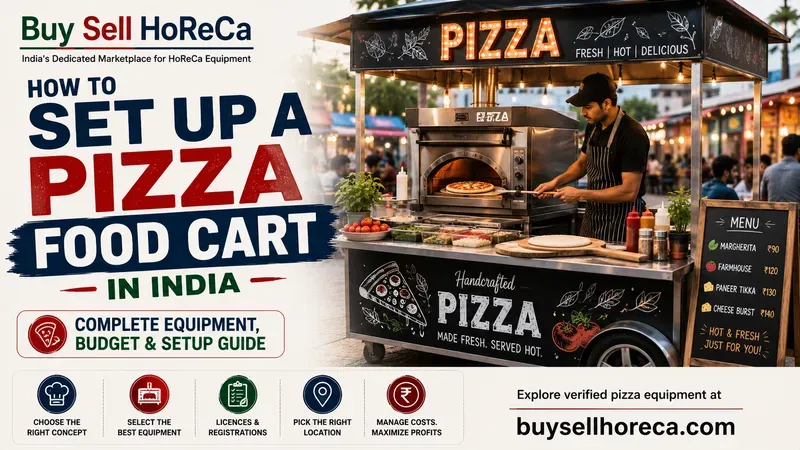
Pizza has become one of India's most popular fast-food categories — and not just in malls and high streets. From college canteens to weekend markets, corporate parks to railway station forecourts, the pizza food cart is emerging as one of the most compelling low-capital food business formats in the country.
The numbers make sense. A well-positioned pizza cart in a high-footfall Indian location can serve 80–150 pizzas a day at a ticket size of ₹80–200, generating gross revenues of ₹8,000–25,000 daily — with significantly lower overheads than a fixed restaurant format. No rental premium for a full kitchen space, no large team, no expensive fit-out. Just a focused product, the right equipment, and the right location.
But a successful pizza food cart is not as simple as buying a cart, a pizza oven, and a few bags of flour. It requires careful thinking about concept, equipment selection, licences, menu design, cost management, and location strategy. This guide walks you through every dimension of setting up a pizza food cart in India — from first concept to first sale.
Step 1: Define Your Pizza Cart Concept
Before any equipment is bought or licence applied for, your concept needs to be clearly defined. In the Indian market, pizza food carts broadly fall into four formats — each with different equipment requirements, target audiences, and price points.
Wood-Fired / Clay Oven Pizza Cart
The most visually dramatic format. A wood-fired or clay oven mounted on or beside the cart creates an unmistakable theatrical element — the sight and smell of a live fire oven is a powerful draw in any footfall-heavy location. Wood-fired pizza cooks in 60–90 seconds at 400°C+, making throughput fast once the oven is at temperature. However, this format requires more setup space, a dedicated fuel supply (wood or charcoal), and additional safety clearances from local authorities.
Best for: Weekend markets, food festivals, melas, upscale residential areas, craft food events, and experiential dining setups.
Gas-Fired Deck Oven Cart
A compact commercial pizza deck oven running on LPG is the most practical and versatile format for a mobile pizza cart in India. Gas ovens are controllable, consistent, faster to heat than wood, and widely serviceable across India. They produce excellent pizza quality, particularly for a thin-crust or New York-style product. This is the most popular format for serious pizza cart operators who want scalability.
Best for: High-footfall permanent pitches, college campuses, corporate parks, high streets, and railway/metro station forecourts.
Electric Conveyor / Deck Oven Cart
For locations with reliable 3-phase or high-amperage electrical supply — such as food courts, malls, or event venues with power connections — an electric pizza oven eliminates the need for LPG cylinder management. Conveyor ovens produce very consistent results and require minimal staff skill.
Best for: Food courts, indoor markets, corporate canteens, and venues with dedicated electrical supply.
Pizza Quesadilla / Flatbread Cart (Low-Capital Entry)
For operators with a very limited starting budget, a flatbread or quesadilla-style pizza on a gas griddle or tawa is a valid entry format — no oven required. The product is different from traditional pizza, but in the right market (college campuses, budget food streets) it can be highly successful at ₹50–80 per portion.
Best for: Budget-sensitive markets, college areas, street food clusters, and operators testing demand before investing in a full oven setup.
Step 2: Licences and Registrations Required
Operating a food cart in India requires several licences and registrations. Requirements vary by state and city, but the core set is consistent across most Indian urban areas.
FSSAI Registration / Licence
Every food cart selling food to the public in India must be registered or licensed with FSSAI (Food Safety and Standards Authority of India). For most small pizza cart operators with annual turnover below ₹12 lakh, a Basic FSSAI Registration applies. Operators projecting higher turnover require a State FSSAI Licence.
The FSSAI registration number must be displayed on your cart and on any packaging used. Application is made through the FoSCoS portal (foscos.fssai.gov.in).
Street Vending / Hawking Licence
Under the Street Vendors (Protection of Livelihood and Regulation of Street Vending) Act, 2014, street food vendors in India are entitled to vend from designated zones and must obtain a Certificate of Vending from the Town Vending Committee (TVC) of their city. Applications are made through the respective Urban Local Body (ULB) or municipal corporation.
Many cities are implementing digital vending licences through municipal portals — check your city's specific process (BBMP in Bengaluru, MCGM in Mumbai, MCD/NDMC in Delhi, GHMC in Hyderabad).
Fire NOC (If Using LPG)
Any cart using LPG for cooking must comply with fire safety requirements for LPG use. For mobile vendors, a basic compliance check and fire safety clearance from the local fire department may be required, particularly if operating in a fixed pitch within a marketplace or event venue. LPG cylinders must be stored and used per BIS safety standards — proper regulators, ISI-marked hoses, and a solenoid shutoff valve are advisable.
GST Registration
If your annual turnover exceeds ₹20 lakh (₹10 lakh in some states), GST registration is required. For most single-cart operators starting out, turnover will likely fall below this threshold initially. Consult a CA to confirm your specific obligation.
Municipal Health / Trade Licence
Most municipal corporations require a health trade licence for food businesses operating within their jurisdiction. This applies to food carts as well as fixed establishments. The licence confirms that the operator meets basic hygiene and public health requirements.
Event and Private Property Permissions
If your cart operates within a private marketplace, food court, event venue, or on private property, you will need written permission from the property owner or event organiser in addition to the above licences. Many premium locations (malls, corporate parks, tech campuses) have their own vendor empanelment processes.
Step 3: Equipment List for a Pizza Food Cart
Equipment selection is the most consequential decision in setting up a pizza cart. Buy the right equipment and your cart runs smoothly, produces consistent quality, and scales with demand. Buy the wrong equipment and you face breakdowns, inconsistent product, and operational frustration.
The Pizza Oven — Your Primary Investment
This is the heart of the cart and where the majority of your equipment budget should go.
Gas-fired pizza deck oven (recommended for most operators): A single-deck commercial pizza deck oven running on LPG, capable of maintaining 350°C–450°C, is the standard for a serious pizza cart. Key specifications to look for:
Internal dimensions: Minimum 60cm × 60cm baking surface to accommodate 12-inch pizzas
Refractory stone or ceramic deck: Absorbs and distributes heat evenly — essential for a properly baked pizza base
Tempered glass door: Allows you to monitor the pizza without opening the oven and losing temperature
Dual or triple burner system: Top and bottom independent heat control for balanced baking
Adequate insulation: Retains heat during the inevitable door-opening of continuous service
Italian-made deck ovens (Moretti Forni, Effeuno, Alfa) are the premium standard but expensive at ₹1.5–4 lakh new. Indian-made commercial deck ovens (available through equipment suppliers in Mumbai, Delhi, Bengaluru, and Hyderabad) offer comparable functional quality at ₹40,000–1.2 lakh new, or ₹20,000–60,000 pre-owned through BuySellHoreca.com.
Wood-fired clay oven (tandoor-style pizza oven): A purpose-built clay or refractory brick dome oven, either wood or charcoal-fired, designed for pizza. Indian artisans and kiln operators in several cities build these to specification. Cost: ₹25,000–80,000 for a cart-mountable unit.
Approximate cost (gas deck oven, new): ₹40,000–1.5 lakh Approximate cost (gas deck oven, pre-owned): ₹20,000–60,000
Dough Preparation Equipment
Pizza dough is made ahead of service — typically one or two days prior for a properly fermented product. If you are producing your own dough (strongly recommended over using pre-made bases for quality and margin reasons), you need:
Spiral dough mixer or planetary mixer: For a cart producing 80–150 pizzas a day, a 5–10 litre spiral or planetary mixer handles daily dough batches efficiently. A planetary mixer with a dough hook is more versatile (can also whisk and paddle for other applications). Brands available in India: Hobart, Electrolux, BMS, Bongard.
New 5L planetary mixer: ₹18,000–35,000
Pre-owned: ₹8,000–18,000
Dough trays and proofing containers: Food-grade polypropylene dough trays with lids for fermentation and transport. Essential for maintaining dough hygiene during the rise.
Cost: ₹800–2,000 for a set of 6
Pizza dough press (optional but useful at scale): A manual or motorised dough press flattens dough balls to a consistent diameter and thickness far faster than hand-stretching — useful when serving speed is critical.
Manual dough press: ₹12,000–25,000 (new)
Pizza Prep and Assembly Station
Stainless steel prep table with under-shelf: Your primary assembly surface. The table must be large enough to hold your mise en place — sauce, cheese, and all toppings — within easy reach. A 1200mm × 600mm stainless steel table with a under-shelf for storage is the standard.
Local SS fabrication: ₹8,000–16,000
Pizza prep refrigerator / topping rail (makeline): A refrigerated prep station with a cutting board surface on top and chilled compartments below for toppings (sauce, cheese, vegetables, meats) keeps ingredients at food-safe temperatures during service. These are called "pizza makelines" or "sandwich prep units." They are high-priority equipment for food safety compliance.
New pizza makeline (1.2m): ₹45,000–85,000
Pre-owned: ₹22,000–45,000
Pizza peel(s): A pizza peel — the long-handled paddle — is used to load and retrieve pizzas from the oven. You need at minimum two: one for loading (dry, floured) and one for retrieval (clean). Aluminium peels are lightweight and widely available.
Cost: ₹1,500–4,000 per peel
Pizza wheel / cutter: A high-quality, heavy-duty pizza wheel with a comfortable grip for rapid, clean cuts.
Cost: ₹500–1,500
Pizza screens and pans: Aluminium pizza screens allow air circulation under the base for a crispier crust. Pizza pans (solid disc pans) are used for a softer, pan-style product. Having both gives you format flexibility.
Cost: ₹300–600 per screen/pan; budget ₹4,000–8,000 for a working set
LPG Gas System
LPG cylinder(s) and manifold: A commercial pizza deck oven running continuously consumes 2–4 kg of LPG per hour. For a full-day operation of 8–10 hours, budget for two to three 14.2 kg domestic cylinders or one to two 19 kg commercial cylinders. A two-cylinder manifold with automatic changeover regulator eliminates service interruption when one cylinder empties.
Manifold with changeover regulator: ₹3,500–7,000
ISI-certified pressure regulator and LPG hose: Use only ISI-marked components throughout the gas supply chain.
Cost: ₹500–1,500 for regulator and hose set
Gas leak detector: A fixed gas leak sensor mounted near the LPG connection point provides critical safety warning for a cart operating in a public space.
Cost: ₹1,500–4,000
Cart and Structural Equipment
The cart/vehicle itself: The physical cart is either a custom-fabricated stainless steel cart, a modified tricycle or cycle cart (for high-mobility formats), or a small trailer (for higher-volume operations or those that relocate frequently). For a gas-fired deck oven pizza cart, the cart must:
Be structurally capable of bearing the oven weight (deck ovens can weigh 80–180 kg)
Have a secure, stable platform at the correct working height (typically 85–90 cm countertop height)
Include adequate storage for LPG cylinders, supplies, and equipment
Have appropriate fire-resistant materials in the oven mounting area
Be weatherproof if operating outdoors
Custom-fabricated SS pizza carts are built in cities like Mumbai, Delhi, Bengaluru, and Coimbatore by commercial kitchen fabricators.
Custom SS pizza cart (basic, without oven): ₹35,000–80,000
Custom cart with oven mounting, gas plumbing, and canopy: ₹75,000–1.8 lakh
Canopy or shelter: An overhead canopy protects operations from the sun and rain — essential for year-round trading in Indian conditions. A retractable or fixed aluminium canopy can be fabricated with the cart or added separately.
Cost: ₹8,000–25,000
Service and Packaging Equipment
Pizza boxes: Branded or plain corrugated pizza boxes appropriate for your pizza size (10-inch, 12-inch). Buying in bulk (500–1,000 units) reduces per-unit cost.
Cost: ₹8–18 per box (plain); ₹12–25 (custom printed with your branding)
Food-grade disposable plates and napkins: For customers eating at the cart or in adjacent seating.
Cost: ₹0.80–2 per plate; ₹0.30–0.80 per napkin
Tissue paper / wax paper for handling:
Cost: ₹500–1,000 per month
POS / billing system: A smartphone-based POS (many free or low-cost apps are available in India — Vyapar, Udhaar, or basic Petpooja mobile) with a Bluetooth thermal receipt printer handles billing, daily sales tracking, and GST compliance.
Cost: ₹3,000–8,000 (printer); most POS software free or ₹500–1,500/month
QR code payment display: Google Pay, PhonePe, and Paytm QR codes are free to generate and essential for cashless payment acceptance in India.
Cost: Nil (laminated printout sufficient)
Cleaning and Hygiene Equipment
Stainless steel handwashing basin with soap dispenser (FSSAI requirement): ₹3,000–6,000
Food-grade sanitiser spray bottles (2): ₹200–400
Colour-coded cleaning cloths (separate for surfaces, oven exterior, and hand drying): ₹400–800
Insulated food-grade containers for ingredient transport: ₹1,500–3,500
Step 4: The Pizza Menu — Keeping It Focused and Profitable
The most common mistake pizza cart operators make is an over-complicated menu. A focused pizza cart menu has three major advantages: faster service, lower ingredient inventory, and higher quality consistency.
A recommended opening menu structure for a pizza food cart:
Base options (2 maximum at launch):
Thin crust (quick cook, crowd-pleasing)
Thick/pan crust (alternative texture, slightly longer cook time)
Sauce options (2):
Classic tomato (house marinara)
White sauce (béchamel or cream-based) for non-tomato eaters — a significant segment of Indian vegetarian customers
Cheese: Mozzarella is the standard. Budget-conscious operators often blend mozzarella with processed cheese (Amul) — this is widely done in the Indian market and has become an accepted product attribute. A full mozzarella product is a quality differentiator worth communicating.
Toppings — recommended selection for Indian market:
Vegetarian (prioritise this category — 30–40% of your customers in most Indian cities will be vegetarian):
Capsicum and onion (most popular)
Sweet corn
Mushroom
Jalapeño and olives
Paneer tikka (an Indianised variant that sells exceptionally well in North India and Tier-2 cities)
Baby spinach and cheese (for health-conscious positioning)
Non-vegetarian:
Chicken tikka (most popular non-veg pizza in India by far)
Pepperoni or salami (available from processed meat suppliers like Godrej Yummiez, Keells, or Vista Foods)
Mutton keema (for markets where pork is not appropriate)
Pizza sizes and pricing (suggested for a cart format):
7-inch personal pizza: ₹80–120 (veg) / ₹110–150 (non-veg)
10-inch standard pizza: ₹150–220 (veg) / ₹190–280 (non-veg)
12-inch sharing pizza: ₹250–350 (veg) / ₹300–420 (non-veg)
Drinks (upsell): Chilled canned beverages (Coca-Cola, Sprite, Maaza) bought in bulk and sold at cart. No preparation required, high margin, and significantly increases average transaction value.
Step 5: Ingredient Sourcing and Cost Management
Flour: Pizza dough uses high-protein flour — ideally 12–14% protein (strong bread flour). Sharbati or good-quality atta does not produce the same results. Suppliers of high-protein pizza flour in India include Pillsbury (professional range), Kwality, and local flour mills producing maida with specified protein content. For an artisan product, Tipo 00 Italian flour is available through specialty import suppliers in major Indian cities.
Cost benchmark: ₹35–55 per kg for good-quality high-protein flour
Cheese: Mozzarella is available in block form (shred yourself — lower cost and better melt) or pre-shredded. Brands available through commercial distributors in India: Amul Mozzarella, Schreiber Dynamix (Kraft), Parag Foods. Pre-shredded is more convenient at the cart but costs 15–20% more per kg.
Cost benchmark: ₹320–480 per kg (mozzarella block); ₹380–520 per kg (pre-shredded)
Tomatoes and sauce: Fresh tomato sauce or tomato purée. Canned Italian tomatoes (San Marzano or standard pomodoro) produce the best sauce base. Bulk tomato purée from domestic brands (Kissan, Del Monte industrial) is a cost-effective alternative.
Food cost target: For a pizza cart, target a food cost ratio of 25–32% of selling price. This leaves sufficient margin to cover labour, packaging, fuel, rent/pitch fee, and licences while generating a reasonable net profit.
Step 6: Location Strategy — The Most Critical Variable
A pizza food cart's success is more dependent on location than almost any other variable. The same cart, the same menu, and the same operator can succeed spectacularly or fail completely depending solely on pitch selection.
High-potential location categories for pizza food carts in India:
College campuses and educational institutions: The highest-volume opportunity for most pizza cart operators in India. Students aged 18–25 are the core pizza consumer, they eat frequently, they share on social media, and they visit in groups (which increases average transaction size). Negotiate directly with the campus administration or canteen contractor for a pitch.
IT parks and corporate campuses: Lunch-hour demand is intense and predictable. Corporate workers are price-tolerant for quality food. Establish a pitch outside or within a technology park for consistent weekday revenue.
Weekend markets and farmer's markets: Cities like Bengaluru, Delhi, Mumbai, Hyderabad, and Pune have vibrant weekend market scenes (Sadashivanagar Market, Dilli Haat, various society markets) that generate excellent footfall for food carts.
Residential society compounds: Many large gated communities hold weekly or monthly food markets in their common areas. A regular slot in a high-density residential society provides a loyal recurring customer base with minimal location competition.
Railway stations and metro station exits: Some of India's busiest footfall locations. Vendors are regulated through the Indian Railways Catering and Tourism Corporation (IRCTC) for inside-station pitches; outside-station pitches fall under municipal jurisdiction.
Food streets and designated vendor zones: Many Indian cities have designated food vendor zones — Juhu Beach in Mumbai, Connaught Place in Delhi, MG Road in Bengaluru, Banjara Hills in Hyderabad. Competition is higher but so is the ambient food-seeking customer traffic.
What to assess when evaluating a pitch:
Daily footfall count (observe at peak hours — lunchtime, evening, weekends)
Customer profile (students, office workers, families, tourists — align with your price point)
Competition audit (how many similar food options already exist at this location?)
Pitch rental cost vs. projected revenue
Power and water access (for cleaning, and electrical oven if applicable)
Waste disposal facilities
Proximity to a water supply for hygiene compliance
Step 7: Staffing Your Pizza Cart
A well-set-up pizza cart can be operated by one skilled person during moderate-volume periods, but two people — one managing the oven and one managing assembly, service, and payment — is the optimal setup for busy service periods.
Roles and skills required:
Pizza maker / oven operator: This is the core skilled role. The pizza maker must be able to hand-stretch dough (or use a press) to a consistent size and thickness, apply sauce and toppings efficiently, load and retrieve pizzas from the oven safely, monitor oven temperature, and maintain service speed during peak demand. Training time for a capable person: 3–4 weeks of consistent practice.
Service and payment staff: Takes orders, manages packaging, handles payments (cash and digital), and keeps the work area clean during service. Can be a less skilled position filled locally.
Staff costs: A cart in a Tier-1 Indian city can expect to pay ₹10,000–18,000 per month for a trained pizza maker and ₹8,000–12,000 for service staff, depending on the city and hours.
Step 8: Full Budget Estimate for a Pizza Food Cart Setup
Startup Cost Breakdown
A smart mix of new equipment where it matters (oven, gas system, safety) and pre-owned or locally fabricated equipment elsewhere (cart, prep fridge, mixer, SS table) brings a quality setup in well under ₹3 lakh — making the pizza food cart one of the most capital-efficient food business formats in India.
Step 9: Operating Costs and Revenue Projections
Estimated daily operating costs (moderate volume cart, 80 pizzas/day):
These are illustrative projections for a productive location. Actual results vary significantly by location quality, footfall, weather, competition, and operational execution.
Payback period estimate: At a ₹2.5 lakh setup cost and ₹1.2–1.5 lakh monthly net operating margin (after loan repayment or depreciation), a well-positioned pizza cart can recover its setup investment in 2–3 months — making it one of the fastest-returning food business formats available.
Step 10: Where to Source Pizza Cart Equipment in India
BuySellHoreca.com is India's dedicated HoReCa equipment marketplace — the most efficient starting point for sourcing pizza cart equipment, whether new or pre-owned. On the platform you will find:
Commercial pizza deck ovens (new and pre-owned) from sellers across India
Pizza makelines and prep refrigeration units
Dough mixers (spiral and planetary)
Stainless steel prep tables and custom fabrication leads
Full cart setups being sold by operators exiting the business
Buying a pre-owned pizza deck oven and pizza makeline through BuySellHoreca.com rather than new can save ₹40,000–80,000 on your setup cost alone — capital better deployed in opening inventory, marketing, and the first month's pitch rental.
Final Thoughts
The pizza food cart is one of the most compelling food business opportunities in India right now — combining a product that has genuine mass-market demand across every major city, a capital investment that is accessible to first-time entrepreneurs, and an operating model that can be profitable from the first month in a well-chosen location.
The operators who succeed are those who take the concept seriously: they invest in the right oven, maintain the dough quality, choose their location with discipline, and stay focused on a tight menu that they execute brilliantly every service. The operators who struggle are those who cut corners on equipment, compromise dough quality, or choose a location based on availability rather than footfall data.
Use this guide as your framework. Source your equipment smartly. Get your licences in place before you trade. Train yourself or your pizza maker until the product is genuinely good. And find a location where the customers already want what you are making.
Looking for commercial pizza deck ovens, prep refrigerators, dough mixers, and stainless steel cart fabrication equipment? Browse new and pre-owned listings at BuySellHoreca.com — India's dedicated HoReCa marketplace.