Fire Safety Requirements for Commercial Kitchens in India
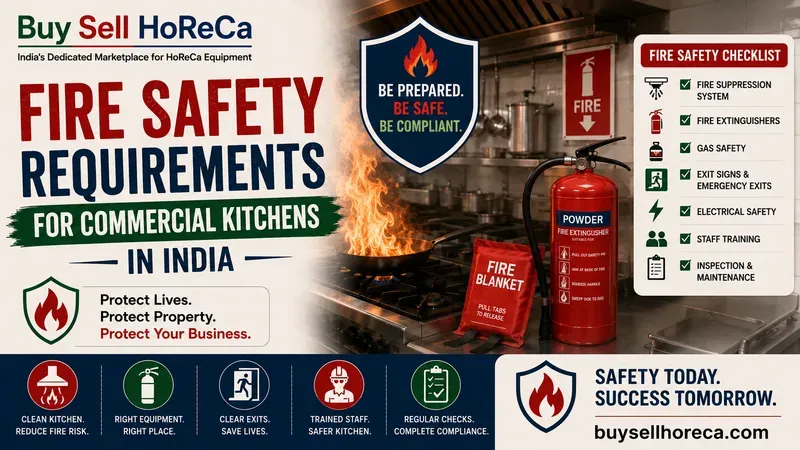
Fire is the single greatest physical safety risk in any commercial kitchen. The combination of open flames, superheated cooking oils, grease-laden exhaust systems, high-pressure gas lines, and the sustained heat of a busy service creates conditions where a fire can ignite in seconds and escalate in minutes. In India, commercial kitchen fires are a leading cause of restaurant closures, property loss, staff injuries, and fatalities — the vast majority of which are preventable.
For restaurant owners and kitchen managers in India, fire safety is not merely a compliance obligation — it is a life-safety imperative. And it is an area where the consequences of negligence are not just financial. A single kitchen fire can injure or kill staff, destroy a premises that took years to build, harm guests, and result in criminal liability for the operator.
This guide covers everything a commercial kitchen operator in India needs to know about fire safety — from the legal framework and mandatory licences to equipment requirements, suppression systems, staff training, and building a kitchen that is genuinely fire-safe rather than just inspection-ready.
The Legal Framework for Fire Safety in India
Fire safety for commercial establishments in India is governed by a combination of national codes, state-level legislation, and municipal regulations. Unlike FSSAI, which has a single central authority, fire safety oversight in India is distributed across multiple regulatory bodies — making it essential for restaurant operators to understand the specific requirements in their state and city.
Key Legislation and Codes
The National Building Code of India (NBC), 2016 The NBC is the primary national reference standard for fire safety in buildings. Part 4 of the NBC covers fire and life safety in detail — specifying requirements for fire compartmentation, exit routes, fire detection and suppression systems, and building construction materials. For commercial kitchens, the NBC specifies ventilation requirements, exhaust duct construction standards, and the mandatory installation of automatic fire suppression systems over cooking equipment.
State Fire Services Acts Each Indian state has its own fire services legislation. These state acts establish the legal authority of the State Fire Department to inspect premises, issue or withhold Fire No Objection Certificates (NOCs), and shut down establishments that pose fire hazards. Key states with active enforcement include Maharashtra (Maharashtra Fire Prevention and Life Safety Measures Act, 2006), Delhi (Delhi Fire Prevention and Fire Safety Act, 1986), Karnataka, Tamil Nadu, and Gujarat.
Model Building Bye-Laws and Local Body Regulations Municipal corporations in major cities — MCGM (Mumbai), NDMC/MCD (Delhi), BBMP (Bengaluru), GHMC (Hyderabad), and others — have building bye-laws that incorporate fire safety requirements. These often go beyond the national minimum standard and are the operative requirements for obtaining a Fire NOC in that city.
Bureau of Indian Standards (BIS) Standards Relevant BIS standards for commercial kitchen fire safety include:
IS 2189 — Selection, installation, and maintenance of automatic fire detection and alarm systems
IS 15683 — Portable fire extinguishers — performance, classification, and testing
IS 2871 — Automatic sprinkler systems
IS 13716 — Carbon dioxide fire extinguishing systems
IS 15105 — Fire and Explosion Protection — guidelines for commercial cooking operations
The Fire NOC — What It Is and Why You Cannot Operate Without It
The Fire No Objection Certificate (Fire NOC) is a mandatory document for all commercial restaurant and food service establishments in India. It is issued by the State Fire Department (or the district fire officer in some jurisdictions) after an inspection of the premises confirms that fire safety standards are met.
What the Fire Department Inspects for a Fire NOC
When a Fire Safety Officer visits your premises for a NOC inspection, they assess:
Adequacy and functionality of fire extinguishers (correct type, quantity, placement, and service date)
Installation and condition of the automatic fire suppression system over cooking equipment
Condition and clearance of emergency exit routes — doors, corridors, and stairwells
Emergency exit door operation — outward-opening, unobstructed, and operable without a key from inside
Presence and legibility of fire exit signage (illuminated or photoluminescent)
Electrical panel condition — MCBs, earthing, and absence of exposed wiring
LPG or PNG gas system safety — pressure regulators, solenoid valves, and flexible hose condition
Storage of LPG cylinders — outdoor or ventilated storage, not inside the kitchen
Kitchen exhaust duct construction and grease management
Fire detection system — smoke detectors and heat detectors in the kitchen and premises
Staff fire safety awareness (sometimes tested through brief questions)
Renewing the Fire NOC
The Fire NOC is typically valid for one year and must be renewed annually. Operating with an expired Fire NOC is a compliance violation and can result in the premises being sealed by municipal authorities or the fire department. Include Fire NOC renewal in your compliance calendar alongside FSSAI licence renewal.
Section 1: Gas Safety — The Primary Ignition Risk
In the majority of Indian commercial kitchens, the primary cooking fuel is LPG (Liquefied Petroleum Gas) from cylinders, or PNG (Piped Natural Gas) from a city gas distribution network. Both are highly flammable — and both require rigorous safety management.
LPG Cylinder Safety
Storage requirements:
LPG cylinders must never be stored inside the kitchen — they must be kept in a designated, well-ventilated outdoor storage area or a dedicated gas storage room with mechanical ventilation.
Cylinders must be stored upright and secured with a chain or bracket to prevent toppling.
The storage area must be free from ignition sources, drains, and pits — LPG is heavier than air and accumulates in low-lying areas.
Empty and full cylinders must be stored separately and clearly marked.
A maximum of two cylinders per cooking station is typically permitted inside or immediately adjacent to the kitchen — check your state fire department's specific limit.
Manifold and connection safety:
Commercial kitchens using multiple cylinders should use a manifold system — cylinders connected through a central manifold with an automatic changeover regulator. This eliminates the need for manual cylinder changes during service.
All flexible hoses connecting cylinders to the manifold or directly to equipment must be ISI-marked, food-grade quality LPG hoses, replaced at the manufacturer's recommended interval (typically every two years regardless of visual condition).
A pressure regulator must be fitted between the cylinder and the gas line — use only ISI-certified regulators.
A solenoid valve (gas solenoid shutoff valve) installed at the main gas entry point allows the entire kitchen gas supply to be cut off remotely — essential for emergency shutoff and recommended for all commercial kitchens.
Leak detection:
A gas leak detector (fixed sensor mounted near floor level, where LPG accumulates) should be installed in any room where LPG cylinders are stored or connected. When triggered, it should sound an alarm and optionally activate the solenoid valve to cut the gas supply.
Staff must be trained in the monthly soapy water leak test — apply soapy water to all connections and watch for bubbling, which indicates a leak.
Never use a naked flame to check for gas leaks. This is the most dangerous and unfortunately common error in Indian kitchens.
PNG (Piped Natural Gas) Safety
For kitchens connected to PNG, the key safety requirements are:
All pipework must be installed and certified by the city gas distribution (CGD) company — unauthorised modifications to PNG lines are illegal and dangerous.
A manual isolation valve must be accessible near the kitchen entrance for emergency shutoff.
An automatic gas shutoff valve linked to a gas detector is strongly recommended for PNG kitchens as well.
PNG pipework must not run through enclosed ceiling voids or wall cavities where leaks could accumulate undetected.
Annual inspection by the CGD company (MGL, IGL, GAIL Gas, or the relevant local distributor) should be maintained and documented.
Section 2: Commercial Kitchen Exhaust and Ventilation — The Hidden Fire Risk
Grease accumulation in kitchen exhaust systems is the second most common cause of commercial kitchen fires after gas leaks — and it is the most commonly neglected fire hazard in Indian restaurants. A grease fire in an exhaust duct is extraordinarily dangerous: the duct acts as a chimney, drawing the fire through the building at speed and making manual suppression nearly impossible.
Exhaust Hood Requirements
Every cooking station using open flame, electric heating elements, or superheated oil must be covered by a correctly sized exhaust canopy or hood.
The hood must extend at least 15–20 cm beyond the cooking equipment on all sides to capture rising hot air, steam, and grease vapour effectively.
Hood height above cooking surface: typically 650–750mm for light cooking (ovens, warmers) and 500–550mm for heavy cooking (fryers, ranges, tandoors) — lower for heavy cooking to capture grease vapour before it disperses.
Grease filters (baffle filters) must be installed in the hood. These capture grease droplets from exhaust air before they enter the duct. Baffle filters must be removed and cleaned in a hot degreasing solution at minimum every week in a busy Indian commercial kitchen — more frequently over fryers and tandoors.
The hood, filters, and internal surfaces must be free from visible grease accumulation at all times. A thick grease deposit is a directly ignitable fuel load positioned directly above your cooking flame.
Exhaust Duct Construction and Maintenance
Exhaust ducts carrying grease-laden air must be constructed from minimum 1.2mm thick galvanised steel or stainless steel — not aluminium foil flex duct, which is a fire and building code violation in a commercial kitchen.
Ducts must be airtight — grease leaking from duct joints onto hot surfaces is a significant fire risk.
All duct runs must include grease collection points (drip troughs) at low points and bends, with drain valves for periodic cleaning.
Access panels must be fitted at regular intervals along the duct to allow professional cleaning.
Professional exhaust duct cleaning by a certified contractor must be conducted at minimum every three months for high-volume kitchens (those with fryers or tandoors) and every six months for lighter operations. This is also a requirement under FSSAI Schedule 4.
Duct cleaning records must be maintained and available for Fire NOC inspections.
Exhaust Fan and Make-Up Air
The exhaust fan must be adequately sized to provide sufficient air changes per hour (ACH) for the kitchen volume and cooking equipment load. An undersized exhaust system means grease-laden air is not fully captured — it deposits on surfaces throughout the kitchen instead.
Make-up air (fresh air supply to replace extracted air) must be provided for any kitchen with mechanical exhaust. Without it, the kitchen operates at negative pressure, which can cause gas appliances to back-draft and affects exhaust capture efficiency.
The exhaust fan motor must be rated for continuous duty and serviced at least annually — a seized exhaust fan is a common cause of grease accumulation escalating to a fire.
Section 3: Fire Suppression Systems
A fire suppression system is the last line of automated defence between a kitchen fire and a catastrophe. In India, automatic fire suppression systems are mandatory under the National Building Code for commercial kitchens above a certain scale, and are increasingly being required by state fire departments, building owners, and insurance providers for all commercial food service operations.
Automatic Kitchen Fire Suppression Systems (AKFSS)
An automatic kitchen fire suppression system is specifically designed for the unique fire hazards of a commercial cooking environment — primarily grease fires (Class K/F fires) and the high temperatures generated by cooking equipment.
How they work: The system consists of a suppression agent tank (typically wet chemical), a network of pipes and nozzles positioned over and around each piece of cooking equipment, and a heat-sensing fusible link or detection line that triggers the system automatically when a fire is detected. Upon activation:
The suppression agent is discharged through the nozzles over the cooking equipment and into the exhaust hood
The gas supply solenoid valve is simultaneously cut — removing the fuel source
The exhaust fan is shut down — preventing the fire from spreading into the duct
An alarm is triggered for staff and, where connected, the fire brigade
Wet chemical agents (potassium-based solutions) are the current standard for kitchen fire suppression. They work through a combination of saponification (converting cooking oils into soap) and cooling, making them highly effective at suppressing grease fires and preventing re-ignition.
Coverage requirements: Each piece of cooking equipment — every fryer, range, griddle, wok station, and tandoor — must have dedicated suppression nozzles providing complete coverage. Do not assume that a suppression system designed for a previous kitchen layout covers new or relocated equipment — any change in kitchen layout requires a system review.
Commissioning and certification: Suppression systems must be installed by a certified fire safety contractor and commissioned with a completion certificate. The system must be inspected and serviced by a certified technician every six months — this is a standard Fire NOC requirement. Service records must be retained.
Sprinkler Systems
Automatic sprinkler systems are required in larger food service establishments under the NBC, in buildings above a certain height, and in food courts or multi-tenant food hall environments. Individual restaurant kitchens in smaller standalone premises may not require full sprinkler coverage — check with your Fire NOC authority.
Where installed, kitchen sprinkler heads must be rated for high-temperature activation (above the ambient temperatures generated in a commercial kitchen during service) to avoid false activation.
Portable Fire Extinguishers
Portable fire extinguishers are the immediate, first-response fire suppression tool available to kitchen staff before a fire escalates beyond manual control. They are mandatory in all commercial kitchens.
Correct extinguisher types for a commercial kitchen:
Critical rule: Never use a water extinguisher on a cooking oil or fat fire. Water causes a violent steam explosion that projects burning oil in all directions — the most dangerous action possible in a kitchen grease fire.
Placement requirements:
A Class K wet chemical extinguisher must be positioned within immediate reach of every fryer and deep cooking oil station — this is the only appropriate first-response tool for a cooking oil fire.
CO₂ extinguishers should be positioned near electrical panels and equipment.
ABC dry powder extinguishers provide general coverage for solid and gas fires.
Extinguishers must be mounted on wall brackets at the correct height — the handle between 0.9m and 1.5m from the floor.
Minimum 1 extinguisher per 200 sq metres of floor area — but in a commercial kitchen, proximity to hazard points matters more than density.
Maintenance:
All fire extinguishers must be inspected monthly for pressure, physical damage, and pin/seal integrity — designated staff member responsible.
Annual service by a certified fire safety company — the service tag on the extinguisher must always be current.
Hydrostatic testing as per manufacturer and BIS specifications (typically every 5 years).
Any extinguisher that has been partially or fully discharged must be refilled and re-certified before being returned to service.
Section 4: Fire Detection and Alarm Systems
Early detection is the difference between a contained kitchen fire and a building fire. FSSAI and the NBC both require adequate fire detection in commercial kitchens.
Smoke Detectors
Standard ionisation or photoelectric smoke detectors are not appropriate for placement directly over commercial cooking equipment — the combination of steam, smoke, and grease vapour from normal cooking operations causes constant false alarms. However, they must be installed in:
Back-of-house storage areas
Dry ingredient stores
Dining areas and front-of-house
Staff areas, offices, and corridors
Heat Detectors
Rate-of-rise heat detectors are the correct device for placement directly in the cooking area and above exhaust hoods. They activate when the temperature rises rapidly (indicating a fire) rather than at an absolute threshold, reducing false alarms from normal cooking heat. Fixed-temperature heat detectors set at an appropriate threshold (typically 58°C–88°C, above normal kitchen ambient) are also appropriate.
Carbon Monoxide (CO) Detectors
In kitchens using gas cooking equipment, a carbon monoxide detector provides critical early warning of incomplete combustion — which can indicate a blocked burner jet, inadequate ventilation, or a gas pressure problem, all of which are fire and health hazards.
Alarm Notification
The fire alarm must be audible throughout the premises — in the kitchen, all dining areas, and staff areas. In multi-floor establishments, the alarm must be audible on all floors. A manual call point (break-glass alarm activation point) should be positioned near the kitchen exit.
Section 5: Emergency Exits and Evacuation
A fire safety system is only as effective as the people who respond to it. Emergency exits and evacuation planning are non-negotiable components of commercial kitchen fire safety.
Emergency Exit Requirements
Every commercial kitchen must have a minimum of two means of egress — at least two separate exits from the kitchen area, in different directions.
Emergency exit doors must open outward in the direction of travel — inward-opening exit doors are a fire safety violation.
Emergency exit doors must be operable without a key from the inside — panic hardware (push bars) is the standard for exit doors.
Exit routes must be maintained completely clear at all times — storing equipment, boxes, or waste in exit corridors is a fire safety violation that is regularly cited during inspections.
Minimum clear width for exit corridors: 1 metre in kitchens and back-of-house areas.
Emergency Lighting
Emergency exit lighting must illuminate exit routes in the event of a power failure. Battery-backed LED emergency lights with a minimum 90-minute battery life are the standard.
Illuminated or photoluminescent exit signs must be positioned above every emergency exit door and at direction changes in exit corridors.
Fire Evacuation Plan
Every commercial kitchen must have a documented, practised fire evacuation plan:
Posted evacuation map displayed in the kitchen showing the primary and secondary exit routes and the assembly point location.
Assembly point designated at a safe distance from the building — marked and communicated to all staff.
Fire marshal designated among kitchen staff — responsible for ensuring all staff have evacuated and for liaising with the fire brigade on arrival.
Fire drill conducted at minimum twice per year — documented with date, staff present, any issues found, and corrective actions.
Section 6: Electrical Safety
Electrical faults are among the leading causes of fires in Indian commercial premises. Kitchen electrical systems face particular stress from high-load equipment, humidity, grease vapour, and the power fluctuations common in India.
Key electrical fire safety requirements:
All kitchen electrical installations must be carried out by a licensed electrical contractor and comply with the Indian Electricity Rules, 2005 and IS 732 (electrical wiring in buildings).
A dedicated electrical distribution board (DB) for the kitchen, with appropriately rated MCBs for each circuit and a main isolator switch accessible from outside the kitchen.
ELCB (Earth Leakage Circuit Breaker) installed and tested monthly by pressing the test button — protects against the most common cause of electrical fire and electrocution.
All electrical fittings in the kitchen must be appropriately rated for the environment — IP44 rated or above for fittings in areas exposed to water, steam, or grease.
No exposed or taped wiring in the kitchen — all wiring must be run in conduit or trunking.
Electrical panels and junction boxes must be kept dust and grease-free — grease accumulation in electrical enclosures is a direct fire risk.
Annual electrical audit by a licensed electrician — checking earthing continuity, insulation resistance, and load balance.
Section 7: Staff Fire Safety Training
Equipment and systems are only effective if staff know how to use them and respond appropriately in an emergency.
Mandatory training elements for all kitchen staff:
PASS technique for fire extinguisher use: Pull the pin, Aim at the base of the fire, Squeeze the handle, Sweep from side to side.
Correct extinguisher selection — which extinguisher type for which fire class, and critically, never to use water on a cooking oil fire.
Kitchen fire response protocol: Raise the alarm first. Attempt suppression only if the fire is small and contained, the exit is behind you, and the extinguisher is the correct type. If in doubt — evacuate.
Gas shutoff procedure — how to locate and operate the main gas isolation valve and solenoid valve shutoff.
Evacuation drill participation — all staff must participate in fire drills twice per year.
What not to do in a fire: Do not use a lift. Do not re-enter the building once evacuated. Do not open doors to rooms where fire is suspected without feeling the door temperature first. Do not attempt to collect personal belongings.
Training should be conducted on induction for all new kitchen staff and refreshed annually. Records of training attendance must be maintained.
Fire Safety Equipment Checklist for Commercial Kitchens
✅ Gas Safety
LPG cylinders stored externally in ventilated designated area
ISI-marked flexible hoses — replaced at manufacturer's interval
ISI-certified pressure regulators on all cylinders
Solenoid shutoff valve at main gas entry point
Gas leak detector installed (for LPG: near floor level)
Monthly soapy water leak test procedure in place
✅ Exhaust and Ventilation
Exhaust hood covering all cooking stations — correctly sized
Baffle grease filters installed — cleaned weekly
Exhaust duct in steel — airtight, with access panels
Professional duct cleaning every 3–6 months — records maintained
Make-up air supply adequate and functional
Exhaust fan in working order — serviced annually
✅ Fire Suppression
Automatic kitchen fire suppression system installed over all cooking equipment
System linked to gas solenoid shutoff and exhaust fan cutoff
Suppression system serviced every 6 months — current service tag
Class K wet chemical extinguisher at every fryer station
CO₂ extinguishers near electrical panels
ABC dry powder extinguishers at general coverage points
All extinguishers on wall brackets — monthly and annual inspection current
✅ Fire Detection and Alarm
Rate-of-rise heat detectors in cooking area and above hoods
Smoke detectors in storage areas, dining area, corridors
CO detectors in gas cooking areas
Fire alarm audible throughout premises
Manual call point at kitchen exit
✅ Emergency Exits and Evacuation
Two exit routes from kitchen — in different directions
Exit doors outward-opening — operable without key from inside
Exit corridors clear of all obstructions
Emergency exit lighting — battery-backed, 90-minute minimum
Illuminated or photoluminescent exit signs at all exits and direction changes
Evacuation map posted in kitchen
Assembly point designated and marked
Fire marshal designated
Fire drill conducted twice per year — records maintained
✅ Electrical Safety
Dedicated kitchen DB with MCBs and main isolator
ELCB installed and tested monthly
No exposed wiring — all in conduit or trunking
Electrical fittings IP44+ rated in wet/steam/grease areas
Annual electrical audit completed — records maintained
✅ Compliance Documentation
Fire NOC current and displayed
Suppression system service records retained
Extinguisher service tags current
Duct cleaning records maintained
Fire drill records maintained
Staff fire training records maintained
The Equipment Investment in Fire Safety
Fire safety compliance requires specific equipment — suppression systems, extinguishers, detection systems, and compliant exhaust installations. For restaurants equipping a new kitchen or upgrading an existing one, understanding what is required from a capital perspective is essential.
The key fire safety equipment items to budget for include:
Automatic kitchen fire suppression system: ₹1.5–5 lakh depending on kitchen size and number of cooking stations, installed and commissioned by a certified contractor
Class K wet chemical extinguishers: ₹4,000–8,000 each (new, certified)
CO₂ extinguishers (4.5 kg): ₹3,500–6,000 each (new, certified)
Gas solenoid valve and gas leak detector system: ₹8,000–20,000
Heat detector (rate-of-rise): ₹2,500–6,000 per unit
Emergency exit lighting and signage: ₹15,000–40,000 depending on premises size
Fire safety equipment should always be purchased new and from certified suppliers — this is the one equipment category where pre-owned purchases are not appropriate. The performance of fire safety equipment at the moment of a fire is life-critical, and the certification and service history of the equipment must be unambiguous.
Explore commercial kitchen equipment — exhaust hoods, stainless steel fabrication, ventilation systems, and more — at buysellhoreca.com, India's dedicated HoReCa marketplace.
Final Thoughts
Fire safety in a commercial kitchen is a system — not a single piece of equipment or a single trained staff member. The gas management, exhaust system, suppression system, detection system, exit routes, electrical safety, and trained personnel must all function together for the system to be effective.
The good news is that building a genuinely fire-safe kitchen is not financially prohibitive — and the cost of doing so is a fraction of what a single kitchen fire typically costs in property damage, stock loss, business interruption, and legal liability. The restaurants that treat fire safety as a daily operational standard — not a pre-inspection exercise — are the ones where a fire that starts never becomes a fire that spreads.
Build the system. Train the people. Maintain the equipment. Renew the NOC. That is fire safety done right.
Equipping a commercial kitchen to fire safety standards? Explore ventilation systems, exhaust hoods, stainless steel fabrication, and more at buysellhoreca.com — India's trusted HoReCa marketplace.
Frequently Asked Questions
Need a Printable Copy?
Download this commercial guide as a formatted PDF to share with your staff, technicians, or print for your kitchen workspace.