FSSAI and Food Safety Compliance for Restaurant Kitchens in India
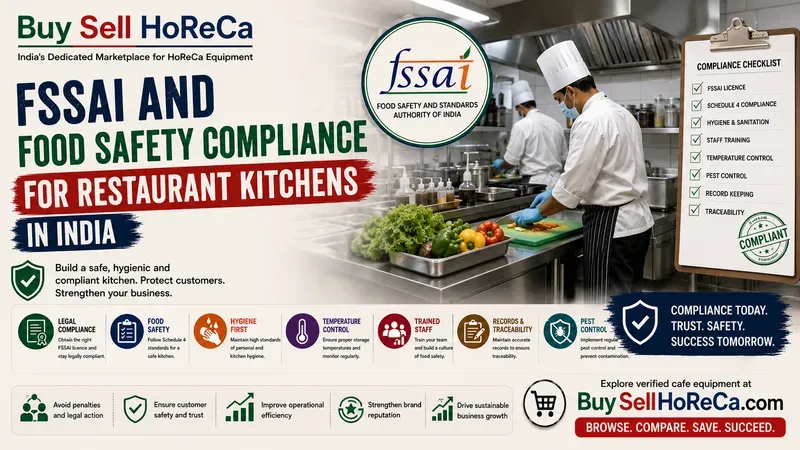
Food safety compliance is not optional for restaurants in India — it is the legal, ethical, and commercial foundation every food business must be built upon. Whether you run a 15-seat neighbourhood café in Pune, a multi-outlet QSR chain in Delhi NCR, a cloud kitchen in Bengaluru, or a fine dining restaurant in Mumbai, the Food Safety and Standards Authority of India (FSSAI) sets the rules you must follow — and the consequences of not following them are serious.
Yet, despite FSSAI being established since 2008 under the Food Safety and Standards Act, a large proportion of India's restaurant operators still treat compliance as a box-ticking exercise before an inspection rather than a daily operational standard. This is a costly misconception. FSSAI compliance done well is not a burden — it is a competitive advantage. A compliant kitchen is a safer, cleaner, more efficient, and more trustworthy kitchen. And increasingly, it is what Indian consumers, food delivery platforms, and institutional buyers actively look for.
This comprehensive guide covers everything a restaurant kitchen operator in India needs to know about FSSAI compliance — from licensing requirements and Schedule 4 obligations to staff hygiene, equipment standards, and how to prepare for an FSSAI inspection with confidence.
What is FSSAI and Why Does It Matter?
The Food Safety and Standards Authority of India (FSSAI) is an autonomous body established under the Ministry of Health and Family Welfare, operating under the Food Safety and Standards Act, 2006 (FSS Act). It is the apex food regulatory authority in India, responsible for:
Setting science-based standards for food products
Regulating the manufacture, storage, distribution, sale, and import of food
Licensing and registering food business operators (FBOs)
Conducting food safety audits and inspections
Running consumer awareness programmes (including the Eat Right India initiative)
Every entity that handles food commercially in India — restaurants, cloud kitchens, hotels, caterers, food manufacturers, importers, and online food businesses — is a Food Business Operator (FBO) and falls under FSSAI jurisdiction.
Non-compliance is not a minor administrative matter. Under the FSS Act, penalties range from ₹1 lakh to ₹10 lakh, and serious violations involving food adulteration or unsafe food causing harm can result in criminal prosecution and imprisonment. Licences can be suspended or cancelled, and FSSAI publishes violation records that can permanently damage a brand's reputation.
Step 1: FSSAI Licensing — Getting the Foundation Right
Which Licence Do You Need?
FSSAI operates a three-tier licensing and registration framework based on business scale:
Basic FSSAI Registration
For food businesses with an annual turnover below ₹12 lakh
Covers very small operators — home bakers, small tiffin services, micro food stalls
Application made through the FoSCoS portal (Food Safety Compliance System)
Registration certificate issued — must be displayed at the food premises
State FSSAI Licence
For food businesses with an annual turnover between ₹12 lakh and ₹20 crore, operating within a single state
Covers the majority of independent restaurants, cafés, QSRs, cloud kitchens, and mid-scale catering businesses
Issued by the State Food Safety Commissioner
Valid for 1–5 years (operator's choice at application)
Central FSSAI Licence
For food businesses with an annual turnover above ₹20 crore, or operating across multiple states
Also required for importers, manufacturers of specific categories, and businesses operating from Central Government premises
Issued by FSSAI headquarters
Valid for 1–5 years
Important Licensing Rules for Restaurant Operators
One licence per location. Each food premises requires a separate FSSAI licence or registration — a restaurant chain with five outlets needs five separate licences.
Display is mandatory. The FSSAI licence or registration certificate must be prominently displayed at every food premises. Non-display is itself a compliance violation.
Renewal before expiry is critical. FSSAI licences must be renewed before the expiry date. Operating with an expired licence attracts the same penalties as operating without one. Set a calendar reminder 60 days before expiry.
Cloud kitchens are fully covered. Cloud kitchen operators must hold a valid FSSAI licence and display the licence number on all food packaging and delivery platform profiles. FSSAI has issued specific guidelines for e-commerce food businesses that apply directly to cloud kitchen operations.
Changes must be notified. Any change in the food business — new menu categories, change of premises, change in proprietorship, or addition of a new outlet — must be notified to FSSAI through a licence modification application.
Step 2: Understanding Schedule 4 — The Operational Compliance Standard
While licensing is the entry requirement, Schedule 4 of the Food Safety and Standards (Licensing and Registration of Food Businesses) Regulations, 2011 is the operational standard that governs how your restaurant kitchen must function every day.
Schedule 4 is structured around several key compliance areas that FSSAI inspectors evaluate during visits. Understanding each one is the basis for building a genuinely compliant kitchen.
2.1 Premises and Infrastructure
Location and surroundings: The food premises must not be located in or adjacent to areas that are prone to flooding, prone to infestation with pests, or exposed to industrial pollutants or foul odours. The immediate surroundings of the kitchen must be kept clean.
Layout and design:
The kitchen must be designed to allow an unidirectional flow of food — from receiving through storage, preparation, cooking, and service — without cross-contamination between raw and cooked food.
Walls in food preparation areas must be smooth, impervious, and washable — tiles or food-safe epoxy paint are the standard. Bare plaster, exposed brick, or paint that flakes is non-compliant.
Floors must be non-slip, impervious, easy to clean, and properly drained. Junctions between walls and floors should be coved (curved, not square) to eliminate dirt-trapping corners.
Ceilings must be free from cracks, flaking, condensation, and mould.
All openings to the outside — windows, vents, and doors — must be screened to prevent pest entry.
Lighting:
A minimum of 220 lux illumination in all food preparation and inspection areas.
A minimum of 110 lux in storage and other working areas.
All light fittings in food preparation areas must have protective shatterproof covers to prevent glass contamination.
Ventilation:
Adequate cross-ventilation or mechanical exhaust to remove heat, steam, smoke, and cooking fumes from the kitchen.
Exhaust hoods must cover all cooking stations.
Ventilation systems must be cleaned regularly — grease-clogged exhaust hoods are a fire hazard and a compliance failure.
2.2 Water Supply and Quality
Water is the single most critical input in any food operation. Schedule 4 requirements are unambiguous:
All water used in food preparation, cooking, cleaning, and ice production must be potable (drinking quality).
The source of water (municipal supply, borewell, or tanker) must be identified and documented.
Water quality testing must be conducted at least once every six months, and test reports must be maintained and available for inspection.
Overhead water storage tanks must be cleaned and disinfected at a minimum of once every six months — records maintained.
There must be no cross-connection between potable water supply lines and wastewater or non-potable lines.
Ice used in beverages or food must be made from potable water and handled only with clean utensils — never by bare hands.
Hot water must be available at a minimum of 40°C at all handwashing stations.
2.3 Personal Hygiene of Food Handlers
This is the compliance area with the most direct impact on food safety. The majority of foodborne illness outbreaks are caused by contamination from food handlers. Schedule 4 is specific:
Medical fitness:
All food handlers must possess a valid medical fitness certificate, renewed annually.
Any food handler suffering from a communicable disease, skin infection, infected wound, diarrhoea, vomiting, or jaundice must be excluded from food handling duties until fully recovered and medically cleared.
Protective clothing and appearance:
All food handlers must wear clean uniforms, aprons, and head coverings (caps or hairnets) at all times in food preparation areas.
No jewellery (rings, bracelets, watches, earrings) may be worn during food handling — items can fall into food and are difficult to sanitise.
Nails must be kept short, clean, and unpolished — nail polish and false nails are prohibited in food handling contexts.
Food handlers must not eat, drink, chew gum, smoke, or use tobacco products in any food preparation or storage area.
Cuts or wounds must be covered with a brightly coloured, waterproof bandage and a protective glove.
Handwashing — the single most important hygiene practice: FSSAI mandates handwashing at the following critical points:
Before starting work and handling food
After handling raw meat, poultry, fish, or eggs
After using the toilet
After handling waste or garbage
After touching the face, hair, or nose
After handling cleaning chemicals
After handling money
After any activity that could contaminate the hands
A dedicated handwashing station with liquid soap, disposable paper towels or a hot air dryer, and a foot-pedal waste bin must be accessible within the food preparation area. The handwashing process must follow the WHO 6-step technique for a minimum of 20 seconds.
2.4 Food Storage
Dry storage:
All dry goods must be stored at a minimum of 15 cm (6 inches) off the floor on clean, sealed shelving.
Storage area must be cool, dry, and well-ventilated — humidity must be controlled to prevent mould.
All bulk ingredients must be in food-grade, labelled, airtight containers — never left in original sacks directly on the floor.
FIFO (First In, First Out) rotation must be strictly followed — older stock moved to the front.
Cleaning chemicals, pesticides, and non-food items must never be stored in the same area as food.
Cold storage:
Refrigerators: 1°C–4°C. Freezers: -18°C or below.
Temperature logs maintained twice daily for all cold storage units.
Raw meat, poultry, and seafood must be stored on the lowest shelves — never above ready-to-eat food.
All cold storage items must be covered or wrapped to prevent cross-contamination and moisture loss.
Refrigerators must not be overloaded — air must circulate freely inside.
Frozen food must be defrosted inside the refrigerator or under cold running water — never at room temperature.
Cooked and high-risk food:
Cooked food must not remain in the temperature danger zone (5°C–60°C) for more than two hours.
Hot holding equipment must maintain food above 60°C at all times.
Cold holding must maintain food below 5°C.
Leftover cooked food must be cooled rapidly — from 60°C to below 5°C within four hours — before refrigeration.
2.5 Food Preparation and Cross-Contamination Control
Colour-coded cutting boards must be used for different food categories:
Red: Raw meat
Yellow: Raw poultry
Blue: Raw seafood
Green: Fruits and vegetables
White: Dairy and cooked foods
Brown: Root vegetables
Separate utensils must be designated for raw and cooked food — and visually distinguished.
Raw and ready-to-eat foods must never be prepared on the same surface simultaneously without thorough sanitisation in between.
The wash-rinse-sanitise three-step process must be followed for all food contact surfaces between tasks.
No bare-hand contact with ready-to-eat food — tongs, gloves, or utensils must be used.
Allergen management must be in place — staff must be trained to identify the 14 major allergens, and allergen information must be available for all menu items.
2.6 Equipment and Utensil Standards
Schedule 4 is specific about the materials and condition of food contact equipment:
All food contact surfaces and equipment must be made from food-grade, non-toxic, non-absorbent, non-corrosive materials — stainless steel Grade 304 or above is the standard for commercial kitchens.
No chipped, cracked, or damaged crockery, utensils, or equipment may be used in food preparation or service.
All equipment must be maintained in a clean and hygienic condition — a dedicated cleaning schedule must be documented and followed.
Thermometers used for food temperature checks must be calibrated and cleaned between uses.
The dishwasher final rinse must reach 82°C for effective sanitisation, or a chemical sanitising rinse must be used as an alternative.
2.7 Cleaning and Sanitisation
A written cleaning schedule must be maintained and displayed in the kitchen, specifying:
What is being cleaned
How often it is cleaned
Who is responsible
Which cleaning chemical is used and at what dilution
Key requirements:
All food contact surfaces must be cleaned and sanitised after every task and at the end of each service.
Cleaning equipment (mops, cloths, buckets) must be colour-coded by zone — kitchen, toilet, and front-of-house equipment must never be interchanged.
Cleaning chemicals must be stored in a separate, locked cabinet — never adjacent to food, packaging, or food equipment.
All chemicals must be in correctly labelled containers at the correct dilution — dispensing measures must be provided.
2.8 Pest Control
A documented pest control programme must be in place, carried out by a licensed Pest Management Agency.
Pest control certificates and visit records must be retained and available for inspection.
A pest sighting log must be maintained — any sighting of rodents, cockroaches, flies, or other pests must be recorded and acted upon.
All external doors must have door sweeps; windows must be screened.
No gaps should exist around pipework, cables, or service entries — all penetrations must be sealed.
Electric Fly Killers (EFKs) must be installed at entry points and in storage areas — not directly above food preparation surfaces; cleaned and emptied weekly.
2.9 Waste Management
Waste bins must have tight-fitting lids and foot-pedal operation — no open bins in food preparation areas.
Wet and dry waste must be segregated at source, as required by the Solid Waste Management Rules, 2016.
Kitchen waste bins must be emptied after every service in high-volume operations.
Used cooking oil (UCO) must be disposed of through a licensed recycler — disposal down drains is both illegal and a municipal infrastructure problem.
Grease traps must be installed and cleaned at the frequency required by your local municipal authority.
Step 3: FSSAI Food Safety Management System (FSMS)
For food businesses above a certain scale — and as best practice for all — FSSAI recommends implementing a Food Safety Management System (FSMS) based on HACCP (Hazard Analysis and Critical Control Points) principles.
An FSMS involves:
Identifying all food safety hazards — biological (bacteria, viruses), chemical (cleaning agents, pesticides), and physical (glass, metal, bone)
Establishing Critical Control Points (CCPs) — the steps in your food production process where hazards can be controlled (cooking temperature, refrigeration, personal hygiene)
Setting critical limits — the maximum or minimum values at each CCP that must be met for food safety (internal temperature of cooked chicken minimum 75°C)
Monitoring CCPs continuously — temperature logs, visual checks, test strips
Corrective actions when a CCP is not met — a procedure for what to do when food exceeds the temperature danger zone, for example
Documentation and record-keeping — the evidence that your FSMS is functioning
FSSAI's FOSTAC (Food Safety Training and Certification) programme provides affordable, government-recognised training for food handlers and Food Safety Supervisors. Completing FOSTAC training:
Satisfies the FSSAI requirement for trained staff in licensed food businesses
Provides staff with a certified qualification in food safety
Significantly improves the practical food safety culture in your kitchen
Step 4: The FSSAI Hygiene Rating Scheme
The FSSAI Hygiene Rating Scheme, launched under the Eat Right India initiative, is a voluntary third-party audit programme that grades restaurants from 1 to 5 stars based on food safety and hygiene compliance.
Why Pursue a Hygiene Rating?
Consumer trust: A 4 or 5-star FSSAI Hygiene Rating displayed at your restaurant entrance and on your delivery app profile is a credible, government-backed signal of food safety commitment.
Delivery platform visibility: Zomato and Swiggy display FSSAI Hygiene Ratings on restaurant profiles. A higher rating directly influences order volume.
Reduced inspection frequency: High-rated establishments face less frequent surprise inspections from FSSAI and state food safety departments.
Brand differentiation: In a competitive market where consumers are increasingly conscious of food safety, a rating sets you apart.
How to Get Rated
Apply through the FSSAI portal (fssai.gov.in). A certified third-party auditor conducts an on-site inspection covering premises, personal hygiene, food safety practices, pest control, documentation, and equipment condition. The audit fee is modest — the rating itself has significant marketing value.
Step 5: Preparing for an FSSAI Inspection
FSSAI inspections can be announced or unannounced. High-rated or compliant establishments generally receive fewer unannounced visits, but every restaurant should be inspection-ready at all times. Here is how to prepare:
The Compliance Document Binder
Maintain a dedicated binder or digital folder containing:
What FSSAI Inspectors Look For
During an inspection, the typical areas an FSSAI Food Safety Officer (FSO) will check include:
Licence display — Is the current, valid FSSAI licence displayed prominently?
Premises condition — Walls, floors, ceilings, lighting, and drainage
Water quality records — Are test reports current and tanks cleaned?
Refrigeration temperatures and logs — Are units at the correct temperature? Are logs being maintained?
Personal hygiene of staff present — Uniforms, head coverings, absence of jewellery, visible handwashing facilities
Pest control records — Current certificates, sighting log
Cleaning schedule — Is it documented and up to date?
Food storage practices — FIFO, raw/cooked separation, proper labelling
Waste management — Segregated bins with lids, absence of open waste
Common Compliance Failures to Avoid
Based on patterns across FSSAI inspections in India, these are the most frequently cited violations:
Expired FSSAI licence — or licence not displayed at premises
Missing staff medical certificates — food handlers without annual fitness checks
No temperature logs — refrigeration being used without any documentation
Raw and cooked food stored together — or raw meat above ready-to-eat items in the refrigerator
Open waste bins in food preparation areas
No dedicated handwashing basin — or handwashing sink used for equipment washing
Pest control certificates expired or only verbal assurance — no documentation
Cleaning chemicals stored near food — unlabelled or undiluted
Water tank not cleaned — no records of cleaning in the last six months
Food handlers not in uniform or head covering — during the inspection itself
FSSAI Compliance for Cloud Kitchens
India's cloud kitchen sector has grown dramatically, and FSSAI has specific compliance expectations for this format:
Cloud kitchens must hold a valid FSSAI licence — the same as any other food business.
The FSSAI licence number must be displayed on all food packaging — printed on labels, stickers, or boxes. This is mandatory, not optional.
All packaging material must be food-grade and FSSAI-compliant — no newspaper, recycled paper, or unlined cardboard in direct contact with food.
Tamper-evident packaging is expected for all delivery orders.
Food must be transported in insulated delivery bags maintaining appropriate temperatures — hot food above 60°C; cold food below 5°C.
Delivery platform profiles (Zomato, Swiggy, Magicpin) must display the FSSAI licence number — this is verified by the platforms.
FSSAI has issued the Food Safety and Standards (Food Products Standards and Food Additives) Regulations specifically covering online food businesses — cloud kitchen operators should review these.
Penalties Under the FSS Act — What's at Stake
Understanding the penalty structure helps communicate the business risk of non-compliance:
Beyond financial penalties, FSSAI can issue improvement notices, prohibition orders (stopping the food business), and licence suspension or cancellation. Violation records are publicly accessible and have a lasting reputational impact.
Building a Compliance Culture — Not Just a Compliance Exercise
The restaurants and cafés that handle FSSAI compliance most effectively are those that have internalised food safety as a daily operational standard rather than a pre-inspection scramble. Here is how to make that cultural shift:
Appoint a Food Safety Supervisor (FSS). For larger food businesses, this is a legal requirement. Even for smaller operations, designating one person as the food safety lead — responsible for maintaining records, conducting internal checks, and coordinating pest control and water testing — significantly improves accountability.
Conduct monthly internal mock inspections. Use the FSSAI inspection checklist as your template. Conduct an unannounced internal audit once a month. Document findings and corrective actions. This builds inspection readiness as a habit rather than a crisis response.
Enrol all food handlers in FOSTAC. Make FSSAI-certified food safety training a condition of employment for every person who handles food in your kitchen. The FOSTAC programme is affordable, widely available, and provides certification that satisfies FSSAI's trained staff requirement.
Make the compliance binder a living document. Update it in real time. When pest control visits, file the certificate the same day. When a staff member renews their medical certificate, update the register immediately. A compliance binder that is always current eliminates pre-inspection panic entirely.
Use technology. Digital temperature logging tools, cloud-based FSMS platforms, and FSSAI's own FoSCoS portal all reduce the administrative burden of compliance while improving the quality of documentation.
The Equipment Dimension of FSSAI Compliance
FSSAI compliance has a direct equipment dimension that is often underappreciated. A kitchen that is structurally non-compliant — with inadequate refrigeration, insufficient ventilation, no dedicated handwashing sink, or food preparation surfaces made from non-food-grade materials — cannot achieve compliance regardless of how well staff follow procedures.
Key equipment investments that directly support FSSAI compliance include:
Stainless steel Grade 304 prep surfaces, shelving, and fabrication — the food-grade material standard
Dedicated handwashing basin with liquid soap dispenser, paper towel holder, and foot-pedal bin
Three-compartment stainless steel sink (wash, rinse, sanitise)
Commercial refrigeration with calibrated temperature displays and adequate capacity
Exhaust hood over all cooking stations — properly sized and regularly cleaned
Electric fly killers positioned at entry points
Lockable chemical storage cabinet separate from food areas
Colour-coded cutting boards, utensils, and cleaning equipment
For restaurants looking to upgrade their kitchen infrastructure to meet FSSAI compliance standards — whether new equipment or quality pre-owned alternatives — BuySellHoreca.com offers verified listings across all commercial kitchen equipment categories from sellers across India.
Final Thoughts
FSSAI compliance is not bureaucratic red tape — it is the operating system of a safe, professional food business. Every requirement in Schedule 4 exists because food safety failures have real human consequences: illness, hospitalisation, and in serious cases, death.
The good news is that full compliance is achievable for any restaurant, regardless of size or format. It requires a valid licence, an organised kitchen team, documented procedures, the right equipment, and a genuine daily commitment to food safety. The restaurant that operates this way does not just pass inspections — it builds the kind of trust with customers, delivery platforms, and institutional clients that sustains a business long-term.
Start with your licence. Add your documentation. Train your staff. Maintain your equipment. And make food safety the first standard your kitchen rises to every single day.
Looking to equip your kitchen to FSSAI standards? Browse new and pre-owned commercial kitchen equipment — stainless steel fabrication, refrigeration, exhaust hoods, and more — at BuySellHoreca.com, India's dedicated HoReCa marketplace.
Frequently Asked Questions
Need a Printable Copy?
Download this commercial guide as a formatted PDF to share with your staff, technicians, or print for your kitchen workspace.